Cyprus or Dubai? Comparing Property Investment for International Buyers (2026)

Co-Founder and CEO, SquareOne
4 דק׳ קריאה

בעמוד הזה
Cyprus and Dubai are often on the same shortlist, but they suit different buyers. Dubai offers no personal income tax on rent and a large, fast-moving market priced in a dollar-pegged currency. Cyprus offers freehold ownership in an EU member state, the euro and a route to permanent residency from €300,000. This guide compares the two on the points that decide most purchases. It is not a recommendation to buy in either.
The main differences
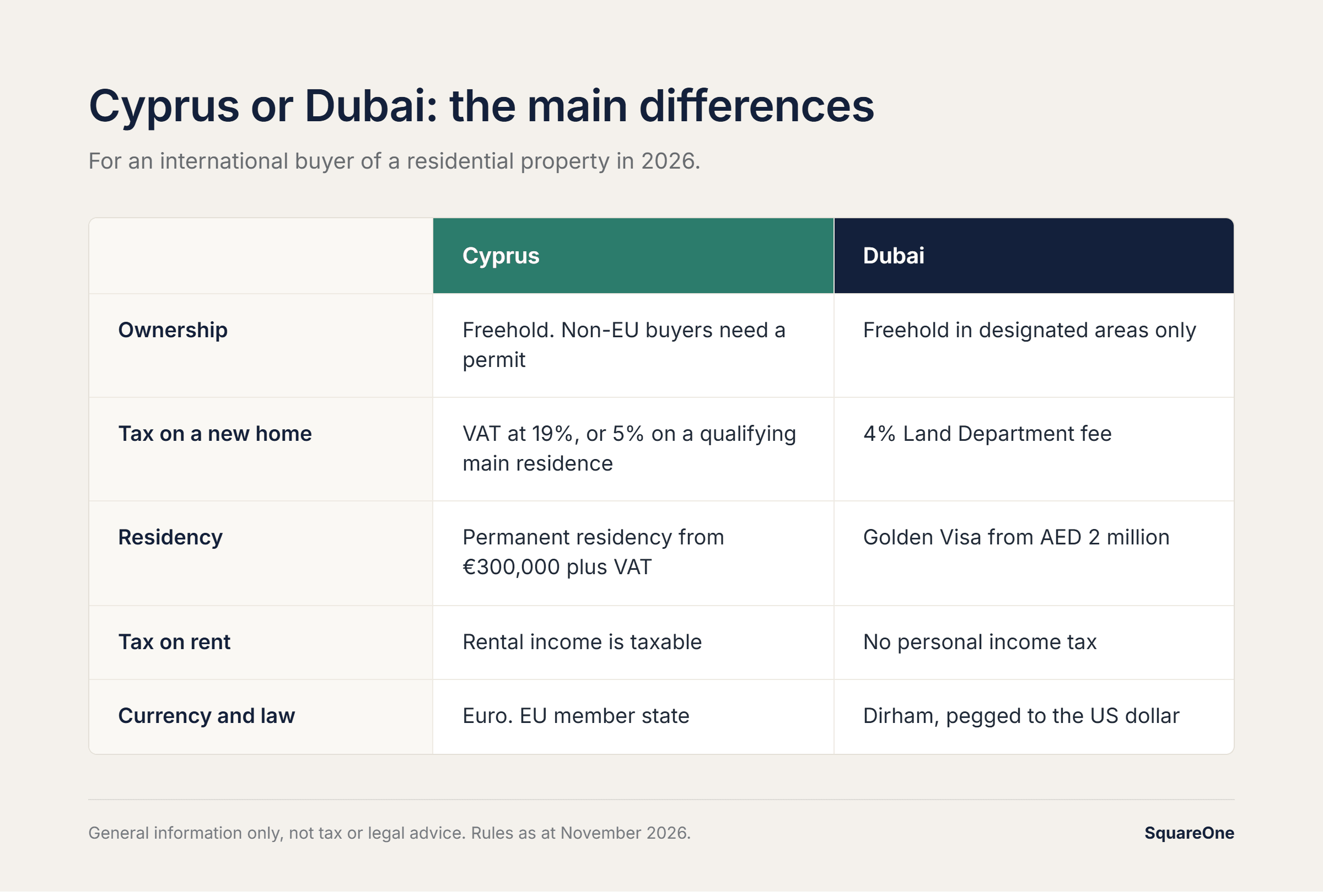
| Cyprus | Dubai | |
|---|---|---|
| Ownership for foreigners | Freehold across the country. Non-EU buyers need a permit | Freehold in designated areas only |
| Tax on purchase | New: VAT at 19%, or 5% on a qualifying main residence. Resale: transfer fees of 3% to 8%, halved | 4% Dubai Land Department fee |
| Other buying costs | Lawyer about 1% plus VAT. No stamp duty from 2026 | Agent 2%, trustee and registration fees |
| Residency through property | Permanent residency from €300,000 plus VAT | Golden Visa from AED 2 million |
| Tax on rental income | Taxable | No personal income tax |
| Annual property tax | None | None, but service charges apply |
| Currency | Euro | Dirham, pegged to the US dollar |
Ownership and legal system
In Cyprus a foreign buyer owns the freehold, with a title deed registered at the Land Registry. EU citizens buy without restriction. Non-EU buyers need permission and face limits on what they can own, as our guide to buying property in Cyprus as a foreigner explains. Cyprus is an EU member state with a common-law legal system.
In Dubai foreigners can own freehold only in designated areas, which include Dubai Marina, Downtown, Palm Jumeirah, Business Bay and Jumeirah Village Circle. Older districts outside those zones are typically leasehold (WhereNext, April 2026).
What it costs to buy
Dubai's costs are simpler. The Land Department charges 4% of the price, the buyer typically pays the agent 2%, and with trustee and registration fees a cash buyer should allow about 7% to 8% in total (Your Overseas Home, October 2026).
Cyprus depends on what you buy. A resale carries transfer fees of 3%, 5% and 8% in bands, currently halved: €8,600 on a €300,000 apartment, or under 3%. A new home from a developer carries VAT instead: 19% as an investment, or 5% on a qualifying main residence. On a €300,000 new apartment that is €57,000 or €15,000. Stamp duty no longer applies to contracts signed from 1 January 2026. Our guides to VAT on property and transfer fees set out the rules.
So a resale or a main residence is cheaper to buy in Cyprus, and a new investment apartment is cheaper to buy in Dubai.
Residency
Cyprus grants permanent residency to non-EU buyers of new property worth at least €300,000 plus VAT, subject to income and other conditions. It covers the family and does not expire. Our guide to permanent residency through property covers the conditions.
Dubai's Golden Visa requires property worth at least AED 2 million, roughly €450,000 to €520,000 depending on the exchange rate. It allows the holder to sponsor a spouse and children. The UAE government portal lists the real estate investor visa as a five-year, renewable permit, although many guides describe it as ten years, so check the current term before relying on it.
Neither is citizenship. A Cyprus residence permit also does not yet give free movement in the Schengen area; our guide to Cyprus and Schengen follows that process.
Tax on rent and on sale
This is Dubai's clearest advantage. Individuals pay no income tax on rent, no capital gains tax and no annual property tax. Owners do pay service charges, typically AED 10 to 35 per square foot a year depending on the building.
In Cyprus rental income is taxable, and gains on the sale of Cyprus property are subject to capital gains tax, with allowances. Our guide to rental income tax in Cyprus explains the 2026 rules. Your own country may also tax your foreign rent wherever the property is, so take advice at home before comparing headline rates.
Rental yields
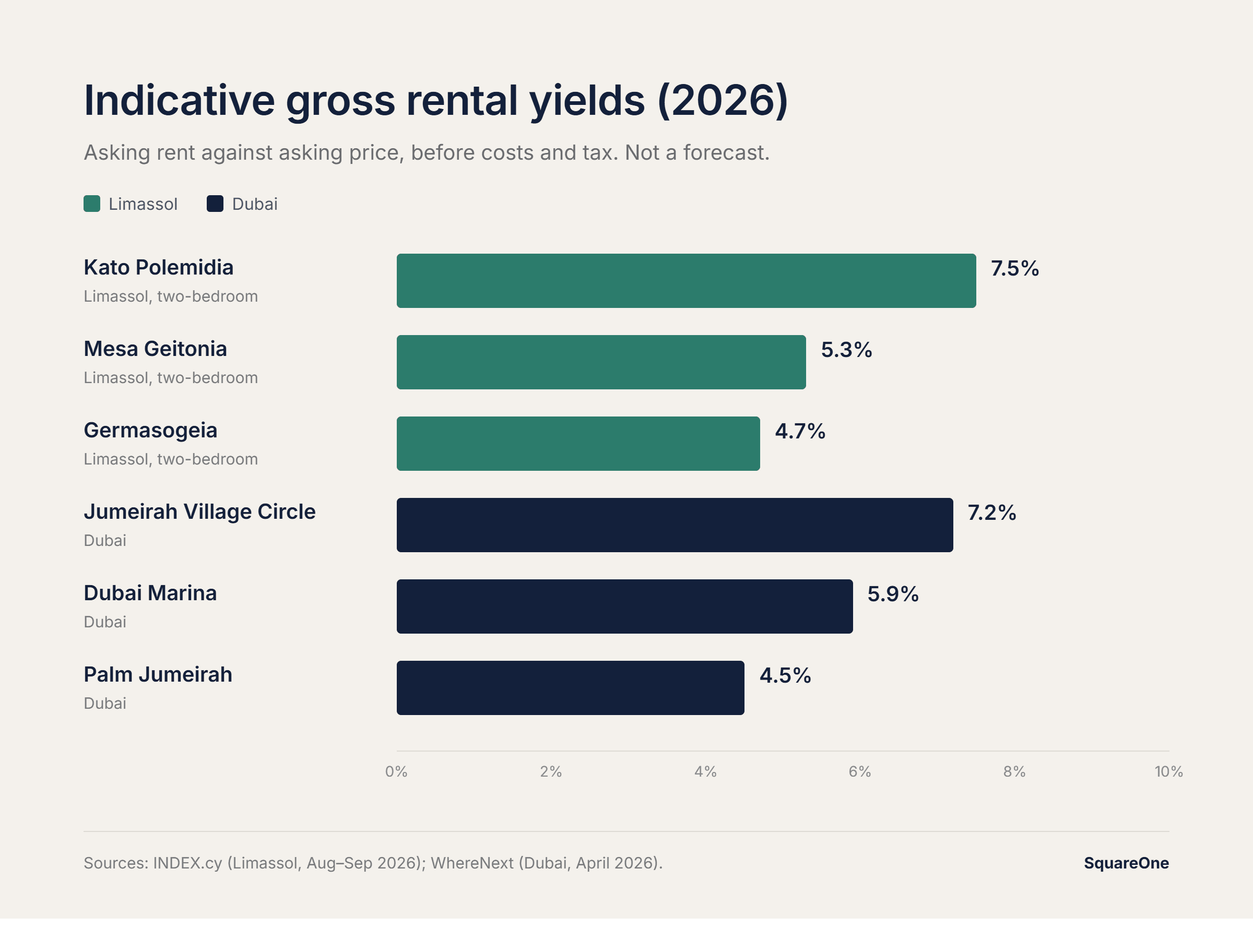
Gross yields overlap more than the reputations suggest. In Dubai, WhereNext puts the average at 6% to 7%, from 7.2% in Jumeirah Village Circle to 5.9% in Dubai Marina and 4.5% on Palm Jumeirah. In Limassol, INDEX.cy listings imply about 7.5% on a two-bedroom apartment in Kato Polemidia, 5.3% in Mesa Geitonia and 4.7% in Germasogeia.
All of these compare asking rents with asking prices, before costs, vacancy and tax. They are not forecasts, and no rental income is guaranteed in either market. Our guide to apartments for sale in Limassol and the buy-to-let guide show how to work out a net figure.
Buying off-plan
Both markets sell heavily off-plan. In Dubai about 70% of sales are off-plan, and buyers' payments go into escrow accounts under rules in place since 2007, according to Your Overseas Home. In Cyprus the protection is the deposit of the sale contract at the Land Registry under the Specific Performance Law, together with a land search and, where the land is mortgaged, the bank's undertaking to release your unit. Our guide to off-plan versus ready property explains how that works.
Scale differs. Limassol has about 4,900 apartments under construction. Dubai expects about 120,000 new homes to be delivered in 2026, according to Your Overseas Home. More supply means more choice, and more competition when you come to let or sell.
Which suits whom
- Dubai may suit buyers whose priority is tax-free rental income, who are comfortable holding a dollar-linked asset and who want a large, liquid market.
- Cyprus may suit buyers who want an EU base and euro asset, a home they can also live in, or permanent residency at a lower entry price.
Many investors hold both. If Cyprus is on your list, our guide to investing in Limassol is the place to start. To see current developments, browse our projects or contact our team.
This article is general information, not tax, legal or investment advice. Rules in both countries change, and Dubai figures are taken from the third-party sources cited. Take professional advice before you buy.
Frequently asked questions
Is property cheaper to buy in Cyprus or Dubai?
It depends on the property. A resale in Cyprus carries transfer fees of under 3% on a €300,000 apartment, against about 7% to 8% total costs in Dubai. A new investment apartment in Cyprus carries 19% VAT, which is more than Dubai's costs.
Can foreigners own property in Cyprus and Dubai?
Yes in both. In Cyprus foreigners own freehold, with non-EU buyers needing a permit. In Dubai foreigners can own freehold only in designated areas.
Which is better for residency, Cyprus or Dubai?
Cyprus offers permanent residency from €300,000 plus VAT in new property. Dubai offers a renewable Golden Visa from AED 2 million. Neither is citizenship, and the conditions differ, so check the current rules.
Is rental income taxed in Dubai and Cyprus?
Dubai charges individuals no income tax on rent. In Cyprus rental income is taxable. Your home country may also tax foreign rental income in either case.
Are rental yields higher in Dubai than in Limassol?
Not consistently. Indicative gross yields in 2026 range from about 4.5% to 7.2% in the Dubai areas cited and from 4.7% to 7.5% in the Limassol areas cited. These are asking-price estimates, not guaranteed returns.
עודכן לאחרונה
על הכותב

Co-Founder and CEO, SquareOne
Demetris Papadopoulos is Co-Founder and CEO of SquareOne, where he leads investment strategy and long-term asset performance. He trained as a Development Analyst at Galliard Homes in London, holds a Master's in Real Estate Investment from Bayes Business School, and co-founded MovingDoors, SquareOne's rental-management platform.
- MSc Real Estate Investment, Bayes Business School
- Co-founder, MovingDoors
- Investment and market analysis