Cyprus Real Estate in 2026: What the Data Shows
8 דק׳ קריאה

בעמוד הזה
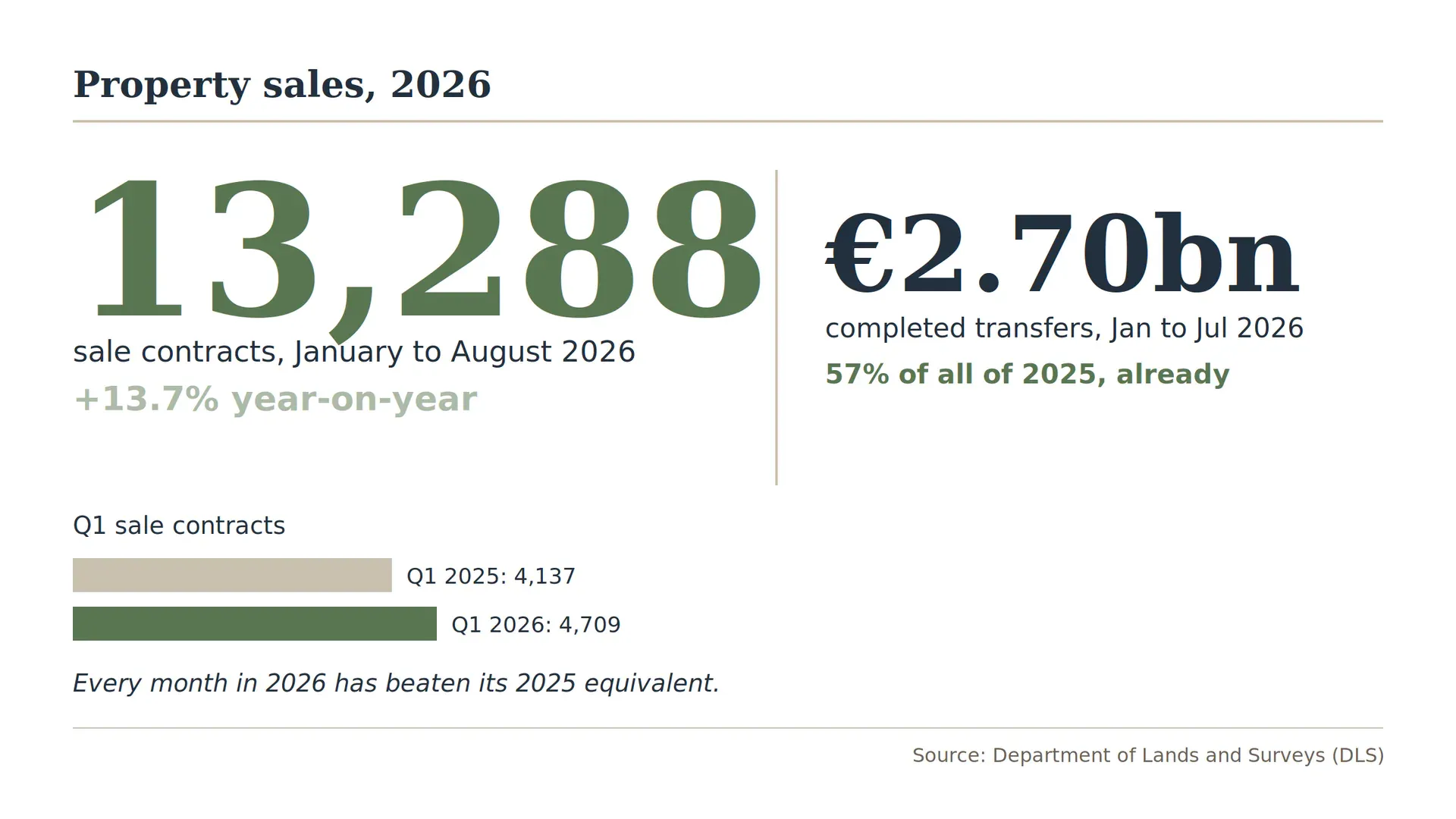
Cyprus recorded 13,288 property sale contracts between January and August 2026, up 13.7% from 11,689 in the same months of 2025. Every month so far this year has come in ahead of its 2025 equivalent. That's the headline, but the detail underneath is more useful.
Everything in this piece is sourced from official data, from the three bodies that measure the Cyprus property market:
- Department of Lands and Surveys (DLS): Registers every sale contract and property transfer.
- Central Bank of Cyprus (CBC): Tracks prices using mortgage valuation data.
- Statistical Service of Cyprus (Cystat): Tracks building permits, construction and tourism.
Where we've drawn on published analysis of that data, it's linked in the sources at the end.
Each body publishes on its own schedule, so the figures cover different windows: sale contracts run through August, completed transfers through July, prices through the first quarter, and permits through May. These are the latest confirmed figures from each source at the time of writing. We'll update this page as new releases land.
How is the Cyprus property market performing in 2026?
Activity is up across the board. The DLS recorded 4,709 sale contracts in the first quarter of 2026, 13.8% more than the 4,137 in the first quarter of 2025. June showed the sharpest growth of any month, up 27.2% year-on-year. July was the busiest, the first month this year to pass 2,000 contracts. August, traditionally the quietest month, still came in 10% ahead of August 2025.
Completed transfers mark the point when ownership actually changes hands, often months or years after a contract is signed. Between January and July 2026, transfers had a declared value of €2.70 billion across 11,522 transactions. That's already more than half of the roughly €4.7 billion transferred in all of 2025, with five months of data still to come.
Are property prices actually rising, and by how much?
Yes, and apartments are rising faster than houses. The CBC's Residential Property Price Index (RPPI) measures average price changes using bank mortgage valuations. It rose 7.5% year-on-year in the first quarter of 2026. Apar tment prices climbed 10.8%, while house prices rose a more modest 3.0%.
On a quarterly basis, growth is steady rather than accelerating. The overall index rose 2.3% on the previous quarter, just below the 2.4% recorded in the fourth quarter of 2025. Apartment price growth slowed to 2.4% for the quarter, while house price growth picked up to 1.5%. That's a market still climbing, not one sprinting.
By district, Limassol posted the highest annual price growth at 9.1%, followed by Larnaca (8.9%) and Paphos (6.4%). Nicosia rose 2.8%, and Famagusta was unchanged.
The longer view adds context. Against the CBC's base period (the first quarter of 2010), apartment prices nationally are 27% higher, and in Limassol they're 53% higher. That gap shows how far Limassol has pulled ahead over the past decade and a half. The latest data suggests the trend is intact but cooling at the margin. Limassol's overall annual price growth moderated in the first quarter, even as its apartment prices accelerated.
None of this is a forecast. A price index measures what has already happened. It isn't a promise about what a specific unit will be worth next year.

Who is actually buying: foreign buyers or Cypriot residents?
Both groups are buying more, but foreign buyers are growing faster. In the first quarter of 2026, DLS figures show:
- Foreign buyers: 2,044 contracts, up 22.3% year-on-year.
- Domestic buyers: 2,665 contracts, up 8.1%.
Through July, non-Cypriot buyers accounted for 41.3% of all contracts, up from 39.2% in the same period of 2025.
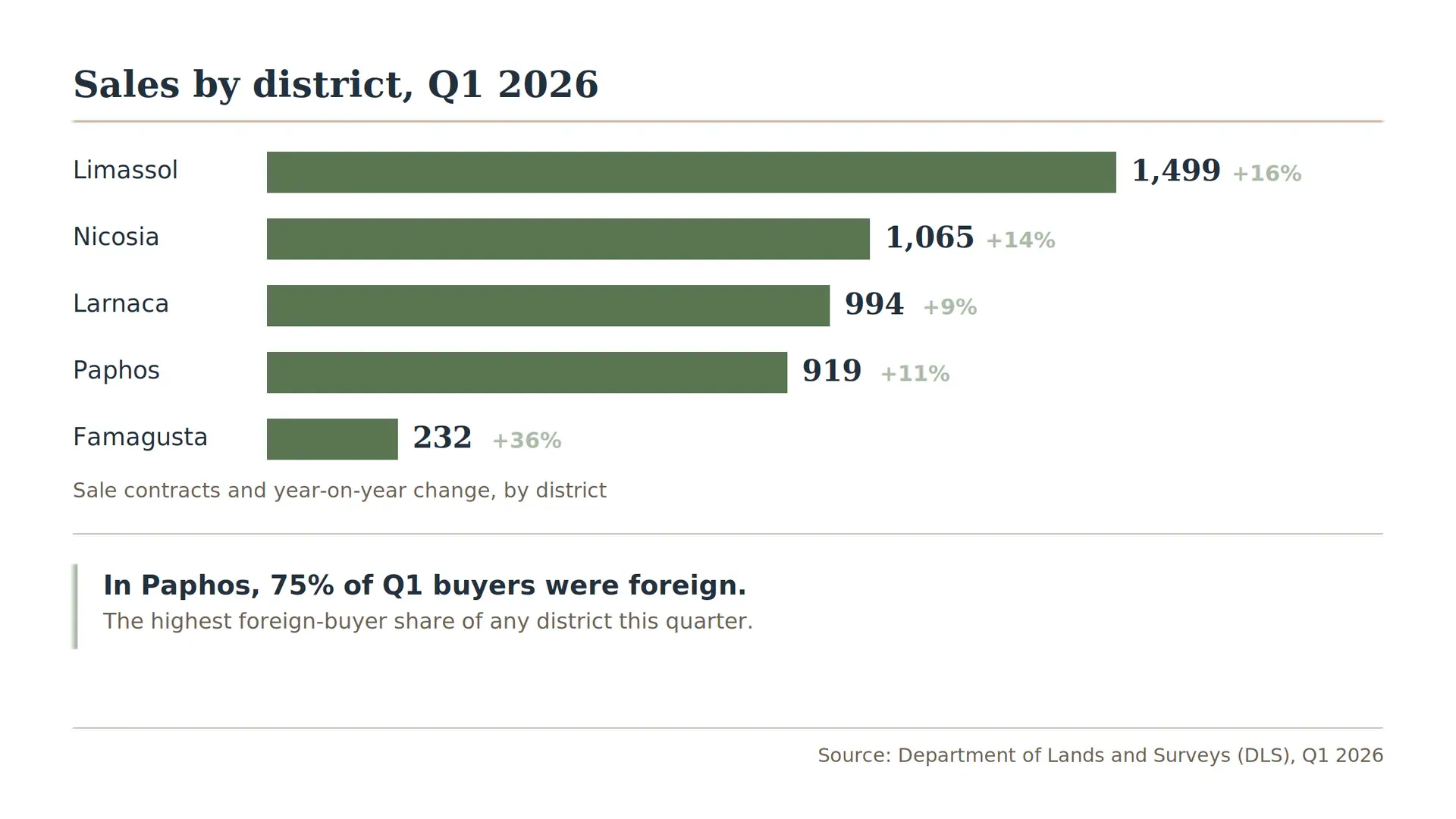
The split varies widely across the island. In the first quarter, foreign buyers made up 75% of transactions in Paphos. Larnaca was roughly balanced between domestic and foreign demand, while in Nicosia, 84% of buyers were domestic. This matters for what gets built and where. A district driven by overseas buyers behaves differently, in pricing and in what sells, from one built on local owner-occupier demand.
Is new supply keeping up with demand?
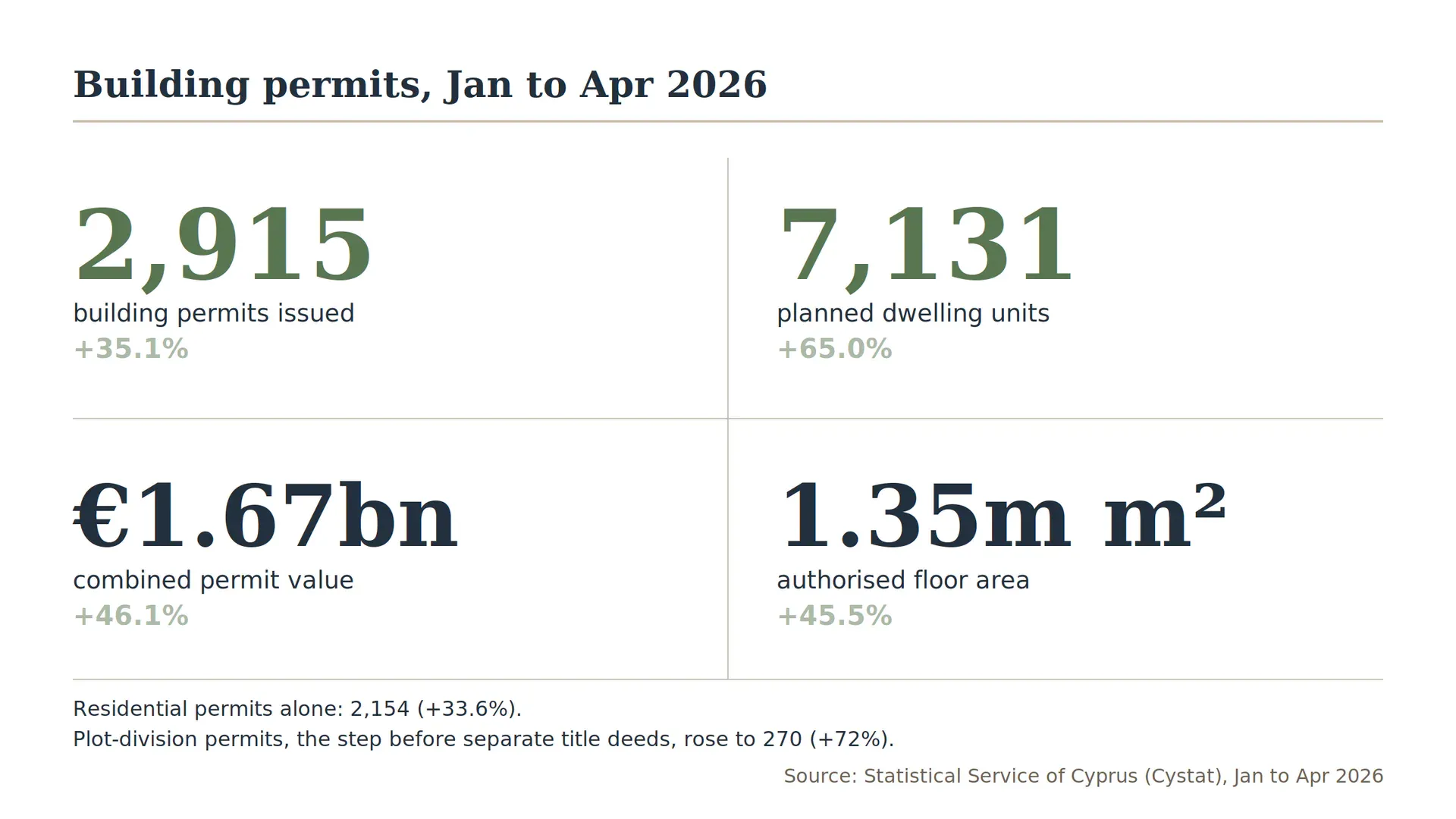
It's catching up quickly, at least on paper. Between January and May 2026, Cystat recorded:
Measure (Jan–May) --- 2026 --- 2025 --- Change
Building permits --- 3,650 --- 2,764 --- +32.1%
Value of permits --- €2.10bn --- €1.46bn --- +43.9%
Dwelling units covered --- 8,978 --- 5,484 --- +63.7%
Residential building permits --- 2,684 --- 2,044 --- +31.3%
Permits for dividing land into separate building plots also rose sharply, by 72% to 270 in the January–April figures. That's an early-stage indicator of future development land, not new homes.
A permit issued today doesn't mean a finished building this year, since turning approvals into completed homes takes time. But the pipeline of what's coming is growing faster than the market that's already selling.
One further data point: this growth came during a difficult year for tourism. Tourist arrivals fell 17.9% year-on-year in January–April as regional conflict disrupted travel, and were still 7% down for January–August, according to Cystat. Property demand in 2026 isn't riding a tourism wave.
Where is the growth actually concentrated?
Limassol leads on most measures. It had the most sale contracts of any district in the first quarter (1,499, up 16%) and 4,354 contracts through August (up 17%). It also accounted for €1.08 billion of the €2.70 billion in completed transfers between January and July. That's around two-fifths of total transfer value from about a third of contracts, which points to higher average prices than elsewhere on the island. August did bring Limassol's first monthly year-on-year dip of 2026, down 5%, though the district remains well ahead for the year.
The other districts:
- Famagusta: Grew fastest in the first quarter, up 36%, from a smaller base.
- Paphos: Has been the fastest-growing district over the eight months, and relies most heavily on foreign buyers.
- Nicosia and Larnaca: Both posted solid, if less dramatic, growth.
Every district is ahead of 2025 year-to-date.
What does this mean if you're buying in 2026?
Three things stand out from the data:
- Demand is broad. Contracts are up in every district year-to-date, and both foreign and domestic buyers increased their purchases nationally, while construction permits expanded.
- Price growth is strongest in apartments and in Limassol. Both trends have run for years, not months, though Limassol's overall pace moderated slightly in the latest quarter.
- Supply is responding. A roughly 64% rise in permitted dwelling units won't fix a shortage overnight, but it suggests the supply constraint is starting to loosen rather than tighten further.
None of this tells you what a specific property will be worth next year. It tells you what has happened, according to the bodies that measure it. Use it to ask sharper questions of any developer or agent, not to skip asking them.
What does the pipeline already tell us about 2027?
One thing doesn't need forecasting. According to Cystat, permits covering 8,978 dwelling units were granted in the first five months of 2026 alone, up 63.7% on the same period last year. Because permitted units take time to become finished homes, a meaningful share of that pipeline will reach the market in 2027 rather than 2026. That's a fact about what's already approved. It says nothing about prices or demand next year, which no single data source can tell you yet.
How much have Cyprus property prices risen in 2026?
According to the Central Bank of Cyprus, the Residential Property Price Index rose 7.5% year-on-year in the first quarter of 2026. Apartments were up 10.8% and houses up 3.0%.
Are foreign buyers or local buyers driving the Cyprus property market in 2026?
Both. DLS figures show foreign-buyer purchases up 22.3% year-on-year in the first quarter of 2026, and domestic purchases up 8.1%.
Which district in Cyprus has seen the strongest property price growth?
Limassol, at 9.1% annual growth in the first quarter of 2026. Its apartment prices are 53% above the CBC's 2010 base, against 27% nationally. The district also accounts for the largest share of both sales volume and transfer value.
Is Cyprus building enough new homes to meet demand?
Supply is expanding quickly. According to Cystat, the number of dwelling units authorised rose 63.7% in January–May 2026, though a permit takes time to become a finished, occupiable home.
Is this a good time to buy property in Cyprus?
Nobody can time a market. What you can control is the price you lock in, the rent the unit earns at today's rates, and how much of the cost you spread over the build. Off-plan lets you do all three: you fix the price now and pay in stages while the building goes up. Past price growth in Cyprus doesn't guarantee future growth in any one district or building, so judge a unit on today's numbers, not on a forecast. If those numbers work for you, the timing question mostly answers itself.
Talk to SquareOne about what this means for your search
The data shows where demand and supply are moving. Matching that to the right project, district and unit type is a separate conversation. Explore our current projects, including ZOIA in Kato Polemidia, or contact us to talk through where the numbers point for what you're looking for.
Sources
- Department of Lands and Surveys
- Central Bank of Cyprus – Residential Property Price Indices
- Cystat – Building Permits: April 2026
- Cystat – Tourist Arrivals: April 2026
- Building permits January–May 2026 (Cyprus Mail)
- BuySell analysis of DLS data, January–August 2026 (Cyprus Mail)
- BuySell analysis of DLS data, January–July 2026 (Cyprus Mail)