Cyprus property outlook: why execution will matter more in 2027 and 2028
7 דק׳ קריאה
בעמוד הזה
In a strong market, very different projects can look equally sound. Rising prices cover cost overruns, limited choice helps ordinary homes sell, and strong demand makes an expensive land purchase look justified.
The next phase of Cyprus real estate may be less forgiving.
The Central Bank of Cyprus (CBC) Residential Property Price Index rose 8.5% year on year in the second quarter of 2026, up from 7.5% in the first quarter. The detail is more mixed: apartment-price growth slowed, districts moved at different speeds, and the number of approved homes rose sharply. (CBC, RPPI Q2 2026)
None of this points clearly to a downturn. It does mean developers and buyers need to look past the national growth rate.
For 2027 and 2028, the more useful question is whether each project still works if price growth slows, competing supply increases and construction stays expensive.
Demand is strong, but growth and market share tell different stories
Department of Lands and Surveys figures, published in the CBC’s second-quarter report, show 5,298 contracts of sale in Q2 2026, up 15.4% from 4,592 a year earlier. The figures cover all property types, not only new homes.
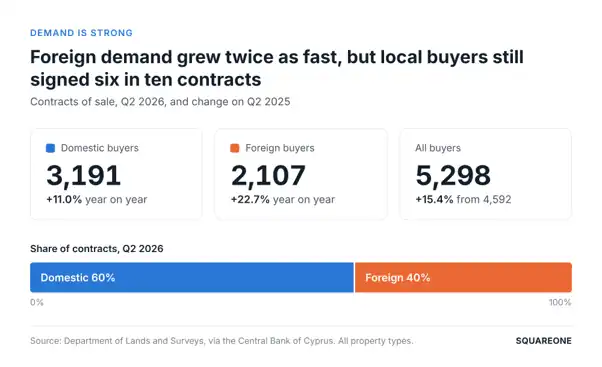
Foreign demand grew faster, but domestic buyers still signed about six in ten contracts in the quarter.
This matters for product design. Homes aimed at local households need a different price point, layout and financing approach from homes designed for overseas buyers.
Local demand was not falling in Q2. It grew 11.0%, just more slowly than foreign demand.
More homes are being approved, but they will not arrive evenly
The clearest sign of future competition is the housing pipeline.
According to CYSTAT data cited by the CBC, building permits approved in January–May 2026 covered 8,978 residential units, up 63.7% from 5,484 in the same period of 2025.
A permitted home is not yet a completed one, though, and a national total says little about how many competing homes will appear in any one neighbourhood.
The CBC treats permits as a leading indicator of construction activity and expects housing supply to keep rising gradually over the medium term. The figures do not show how many of these homes will be finished in 2027 or 2028.
Competition is best assessed project by project:
- Which nearby schemes have permission?
- Which have started construction?
- How many homes target the same buyer and budget?
- When are they likely to become available?
- What will make one home more useful or appealing than another?
More approved supply is a reason for closer analysis. On its own, it does not prove an imminent surplus or a fall in prices.
Cyprus is not one housing market
The national index hides real differences between districts.
In Q2 2026, annual price growth ranged from 5.7% in Nicosia to 10.0% in Famagusta. Limassol slowed from 9.1% in Q1 to 7.8% in Q2.
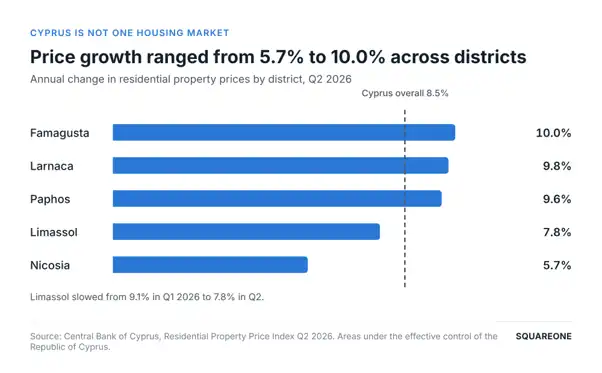
Slower growth in Limassol does not mean prices are falling there, and one quarter is not enough to say the district has reached a plateau.
Property type matters too. Nationally, apartment-price growth slowed from 10.8% in Q1 to 8.9% in Q2, while house-price growth rose from 3.0% to 5.8%. In Paphos, apartment prices rose 18.5% year on year, against 3.1% for houses.
So a district growth rate is not a forecast for every apartment, street or price bracket within it.
The better comparison is with homes that meet the same need: similar location, size, condition, delivery stage and total purchase cost.
Building costs remain a separate pressure
More homes in the pipeline do not make them cheaper to build.
CYSTAT’s construction-materials price index rose 3.39% year on year in August 2026, and 2.06% for January–August compared with the same period of 2025. The two figures cover different periods and should not be compared directly. (CYSTAT, via gov.cy)
Increases varied by material. Annual rises in August included:
- Metallic products: 4.60%
- Wood, insulation materials, chemicals and plastics: 4.60%
- Electromechanical products: 3.58%
- Cement: 4.79%
Materials are only part of the cost. The CBC also points to construction labour shortages and elevated wages as sources of upward pressure on property prices. (CBC)
If competing supply caps selling prices while construction and holding costs keep rising, margins get tighter. That squeeze is possible, not certain.
Stripping out features until the budget works is the wrong answer. A better one is to design more efficiently, fix specifications early, check supplier capacity and allow realistically for delays and changes.
Financing needs closer scrutiny than a single headline rate
The ECB’s deposit facility rate has been 2.50% since 16 September 2026. It shapes the financing backdrop, but it is not the rate homebuyers or developers actually pay. (ECB)
Cyprus mortgage figures also need careful reading.
The CBC reported a January 2026 housing-loan rate of 3.70% for floating-rate loans and loans fixed for up to one year. Its Q2 property report gives a June average of 3.23% across all fixation periods. Because the two figures cover different loans, they cannot be read as a like-for-like trend.
The CBC also notes that a shift in the mix of housing loans can move the weighted average even when banks’ underlying rates have not changed.
For households, what matters is the actual monthly cost of the loan, including what happens when any initial fixed-rate period ends.
For developers, it is whether the project can carry its debt and running costs if reservations, sales or completions take longer than planned.
Buyer geography should shape the product
Department of Lands and Surveys data also show why one national sales strategy is unlikely to suit every district.
In Q2 2026, domestic buyers accounted for 84% of contracts in Nicosia, 66% in Limassol and 57% in Larnaca. In Paphos, foreign buyers accounted for 66%.
These are buyer categories. They say nothing about income, mortgage use or whether buyers will live in the home, so they cannot measure affordability on their own.
They do show that product decisions should start with a clear view of the likely buyer.
A home for a local household should be tested against its full cost of ownership: purchase price, financing, energy use, maintenance, shared charges and daily travel. A low asking price helps little if the home is expensive or awkward to live in.
For SquareOne, this is where the commercial case and the company’s purpose meet: making better urban living attainable for the people who will live in these homes.
What good execution looks like over the next 24 months
The evidence supports a more selective approach to development. It does not support a blanket prediction that the market will rise or fall.
Five priorities follow from this.
- Buy land against a conservative plan
Test the purchase price against realistic sales values, full development costs and a credible delivery schedule. The acquisition should work without relying on future price growth. - Design around a defined household
Layout, storage, light, energy performance and access to daily needs should follow a clear brief. A good location is a starting point; the home still has to work on its own merits. - Reduce avoidable cost uncertainty
Set specifications early, confirm long-lead items, check contractor capacity and hold a realistic contingency. - Stress-test time as well as price
Model flat selling prices, higher financing costs and slower sales, separately and together. Delays can weaken a project even when final selling prices hold. - Treat handover and after-sales as part of the home
Plan clear communication, a well-managed handover and a defined process for fixing defects from the start of the project.
A stronger market case starts with a better home
Cyprus entered the second half of 2026 with rising prices, more sales and a much larger pipeline of approved homes. Material costs and labour shortages continued to affect delivery.
There is still room for opportunity, but less room to rely on market growth alone.
The strongest case for a development is a home people can afford, want to live in and trust to be delivered as promised.