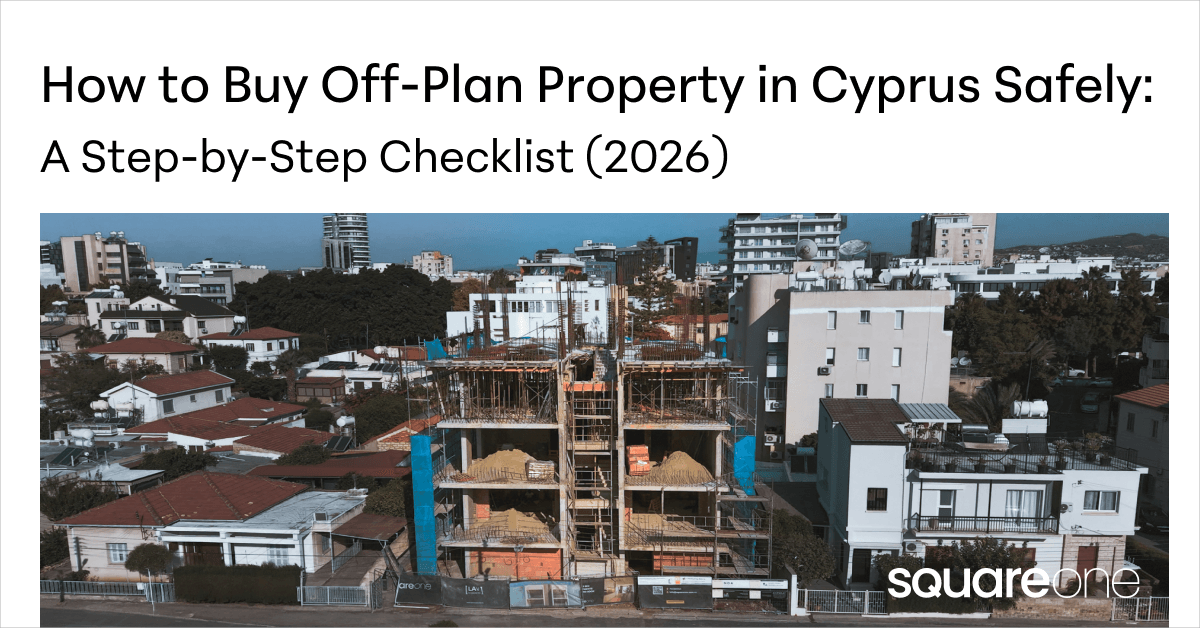
How to Buy Off-Plan Property in Cyprus Safely: A Step-by-Step Checklist (2026)

Автор: Nikitas Papadopoulos
Co-Founder and COO, SquareOne
4 мин чтения
Содержание
Buying off-plan in Cyprus means signing for a home that is not built yet and paying for it in stages while it goes up. Done carefully, it gets you a new home at today's price. The protection comes mainly from checks you make before signing and from registering your contract at the Land Registry afterwards. This checklist walks through each step in order.
It is general information, not legal advice. Use an independent lawyer for your own purchase. If you are still deciding between a new or a finished home, start with our comparison of off-plan and ready properties.
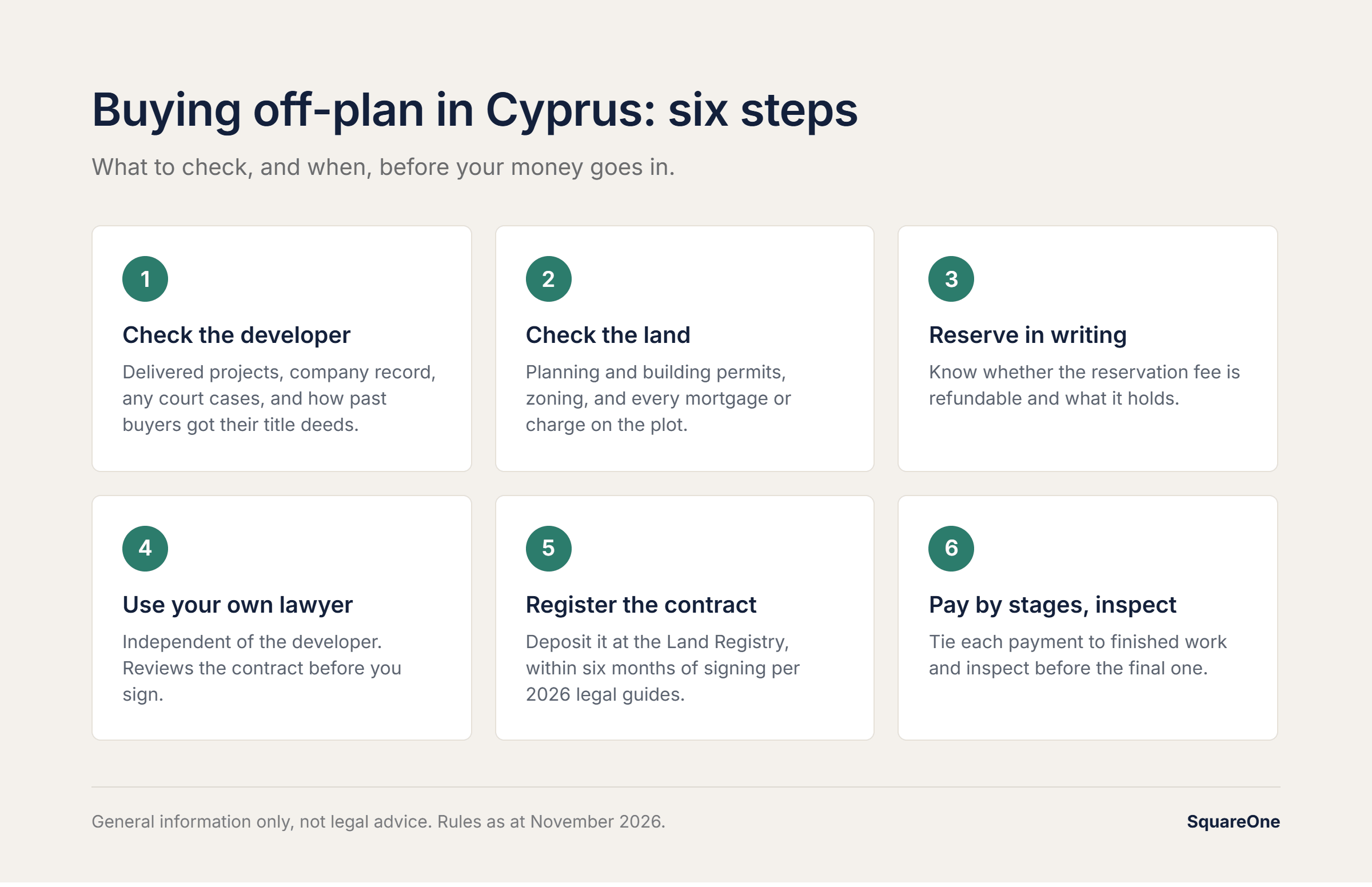
Step 1: Check the developer
The developer's track record matters more than the brochure. Ask for:
- Delivered projects. Visit one or two finished buildings and, if you can, speak to owners.
- Title deeds on past projects. Ask whether earlier buyers have received separate title deeds, and if not, why. Our guide to title deeds in Cyprus explains the process.
- Company records and court cases. Your lawyer can check the company registry and any litigation.
Our guides to choosing a property developer in Limassol and to property developers in Cyprus cover this in more detail.
Step 2: Check the land and the permits
Before you reserve, your lawyer should confirm:
- Planning and building permits are issued for the building you are buying, and the plans match what you are shown.
- Zoning and restrictive covenants allow the use and the number of floors.
- Mortgages and charges on the land. Developers often fund construction with a bank loan secured on the plot. If there is one, the bank's written commitment to release your unit should be in place, as Connor Legal's 2026 guide advises.
For contracts signed from 12 December 2023, the seller must attach a Land Registry search certificate dated no more than five working days before signing, according to A. Danos & Associates on Mondaq (September 2026). It lists any mortgages, charges and other claims on the property.
Step 3: Reserve in writing
A reservation fee takes the unit off the market while your lawyer works. Get a short written agreement that states the amount, how long the reservation lasts and whether the fee is refundable if the checks raise a problem. Some reservation documents can bind you, so read it before paying.
Step 4: Have your own lawyer review the contract
Use a lawyer who acts only for you, not one the seller provides. The contract should set out the price, the payment schedule, the specification and the completion date. Clauses worth asking for include:
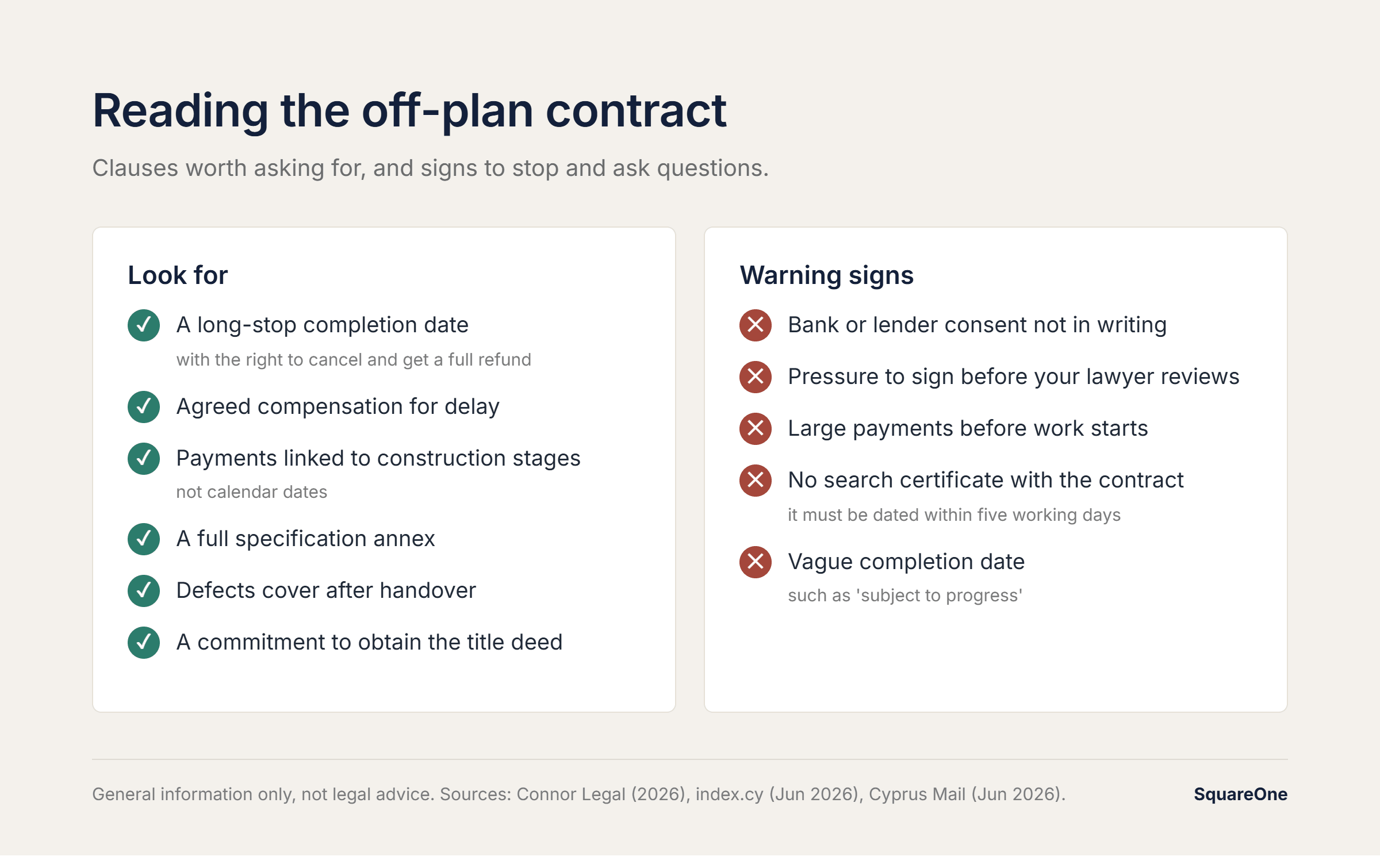
- A long-stop completion date, after which you can cancel and get your money back.
- Agreed compensation for delay.
- Payments linked to construction stages, not calendar dates.
- A detailed specification annex: finishes, kitchen, air conditioning, energy class.
- Defects cover after handover. Connor Legal suggests at least 24 months.
- A commitment that the developer will obtain the separate title deed.
- A bank guarantee or performance bond on your payments, where the developer offers one. It is a useful protection, but no source we found shows it is required by law in Cyprus.
Step 5: Register the contract at the Land Registry
This is the single most important protection. Under the Specific Performance Law (Law 81(I)/2011, as amended), you deposit the signed contract at the District Land Registry. Once deposited, the property cannot be sold to someone else or mortgaged against you, and you can go to court to enforce the sale. Connor Legal and A. Danos & Associates both give six months from signing as the deadline; do it as soon as you can.
Two 2026 changes are worth knowing:
- Stamp duty has gone. Law 239(I)/2025 repealed stamp duty for documents signed from 1 January 2026, so new contracts no longer need stamping.
- The 2025 "trapped buyers" law looks backwards. Law 110(I)/2025 helps buyers whose contracts were deposited by 31 December 2014 or who went to court by 31 December 2024, as a Cyprus Mail column (June 2026) explains. A buyer signing today should not expect to rely on it, which is why the earlier checks matter.
Step 6: Pay by stages and inspect before handover
Off-plan prices are paid in instalments: a reservation fee, a payment on signing, payments as the building reaches set stages, and a final payment at handover. Tie each payment to finished work you or your adviser can see. VAT is added to each payment: 19% as standard, or 5% for a qualifying main residence (the first 130 m² and up to €350,000, for a home of no more than 190 m² and €475,000). Our VAT guide has the detail.
Before the last payment, inspect the apartment with a checklist or an independent engineer, and list every defect in writing. Transfer fees and title registration come later; see our guide to transfer fees in Cyprus.
Buying off-plan with SquareOne
We sell our projects directly and through partner agents. Every buyer gets the full contract, the permits and the payment schedule to review with their own lawyer before signing. You can see our current off-plan buildings in our round-up of off-plan developments in Cyprus, browse all projects or contact our team with questions.
Frequently asked questions
Is it safe to buy off-plan property in Cyprus?
It can be, if you check the developer, the permits and any mortgage on the land before signing, use your own lawyer, and deposit the contract at the Land Registry. These steps protect most buyers from the problems seen in the past.
How long do I have to deposit my contract at the Land Registry?
Legal guides from 2026 give six months from signing under the Specific Performance Law. It is best to deposit it as soon as possible after signing.
Do I still pay stamp duty on a property contract in Cyprus?
Not on documents signed from 1 January 2026. Law 239(I)/2025 repealed stamp duty from that date. Contracts signed before then follow the old rules.
Is a bank guarantee required for off-plan payments in Cyprus?
We found no legal requirement for one. Some developers offer a bank guarantee or performance bond, and it is worth asking your lawyer to request one.
What VAT do I pay on an off-plan apartment?
VAT is charged with each payment: 19% as standard, or 5% on the first 130 m² and up to €350,000 if the home is your main residence and meets the size and value limits.
Обновлено
Об авторе

Co-Founder and COO, SquareOne
Nikitas Papadopoulos is Co-Founder and COO of SquareOne. A Master of Architecture graduate of the Architectural Association in London, he leads how SquareOne's vision becomes built homes, from design through project delivery to everyday life in them.
- Master of Architecture, Architectural Association, London
- Design and project delivery