Buying Property in Cyprus as a Foreigner: The Step-by-Step Process (2026)

Co-Founder and CEO, SquareOne
4 min read

On this page
Foreign buyers sign about four in ten property contracts in Cyprus. In the first nine months of 2026 they signed 6,267 of 14,969, two-thirds of them from outside the EU. The process is well established, but it differs depending on whether you're an EU citizen. This guide walks through it step by step, with the rules and costs as they stand in 2026.
EU and non-EU buyers: what's different
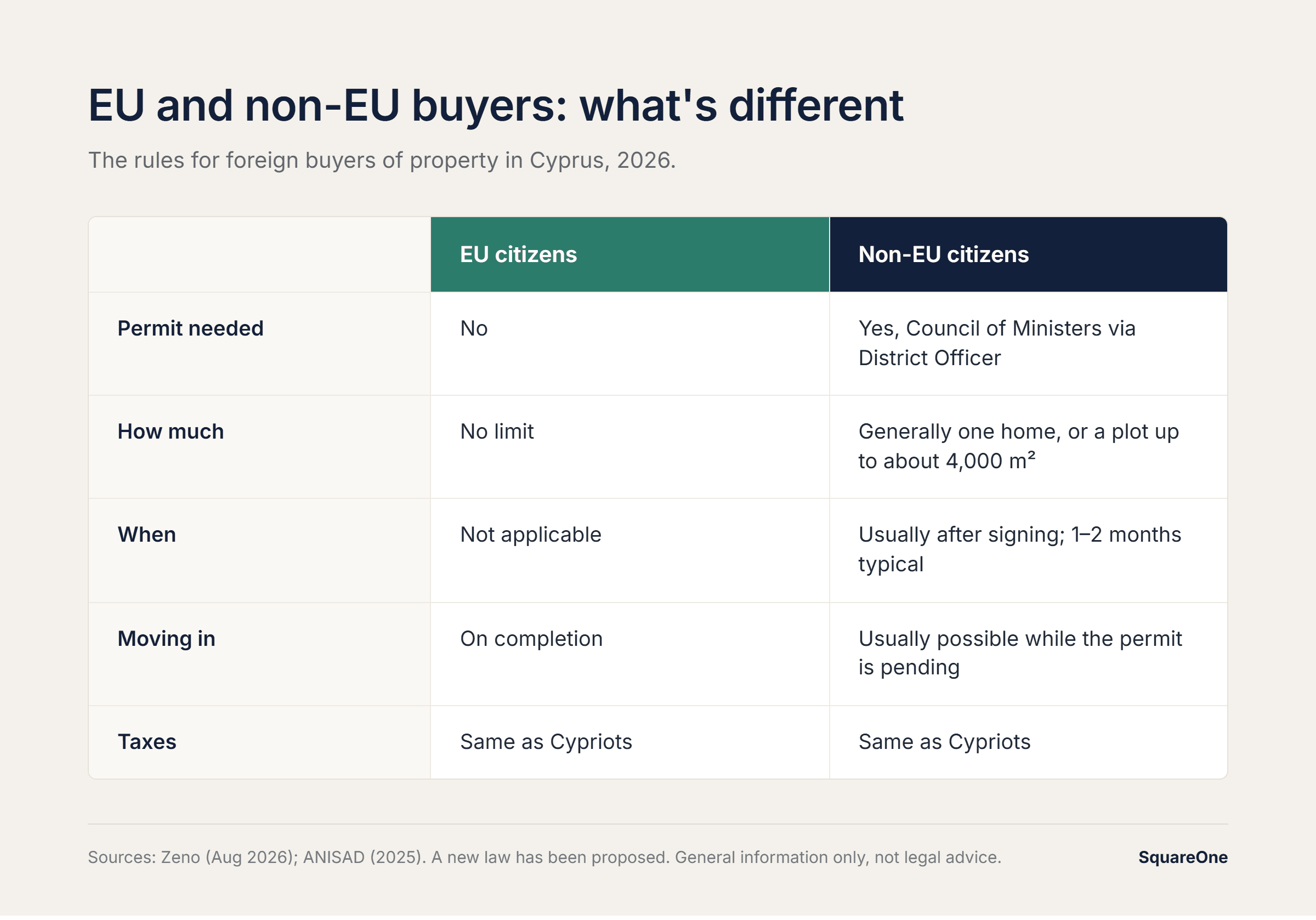
EU citizens can buy as many properties as they like, on the same terms as Cypriots, with no permit.
Non-EU citizens need permission from the Council of Ministers, applied for through the District Officer, usually after signing the contract. Under the current law, a non-EU buyer can generally acquire one home, or a plot of up to about 4,000 m² for one home. Permission for an ordinary residential purchase is rarely refused, and it typically takes one to two months, sometimes longer in Paphos. You can usually move in while the application is pending, but the title can't be registered in your name until it's granted.
The government has been preparing a new law on purchases by non-EU buyers. Proposals discussed in 2025 and 2026 include tighter limits on size and stricter checks on companies owned by non-EU buyers. As of November 2026 they had not become law. Your lawyer can confirm the current position before you sign.
Step by step
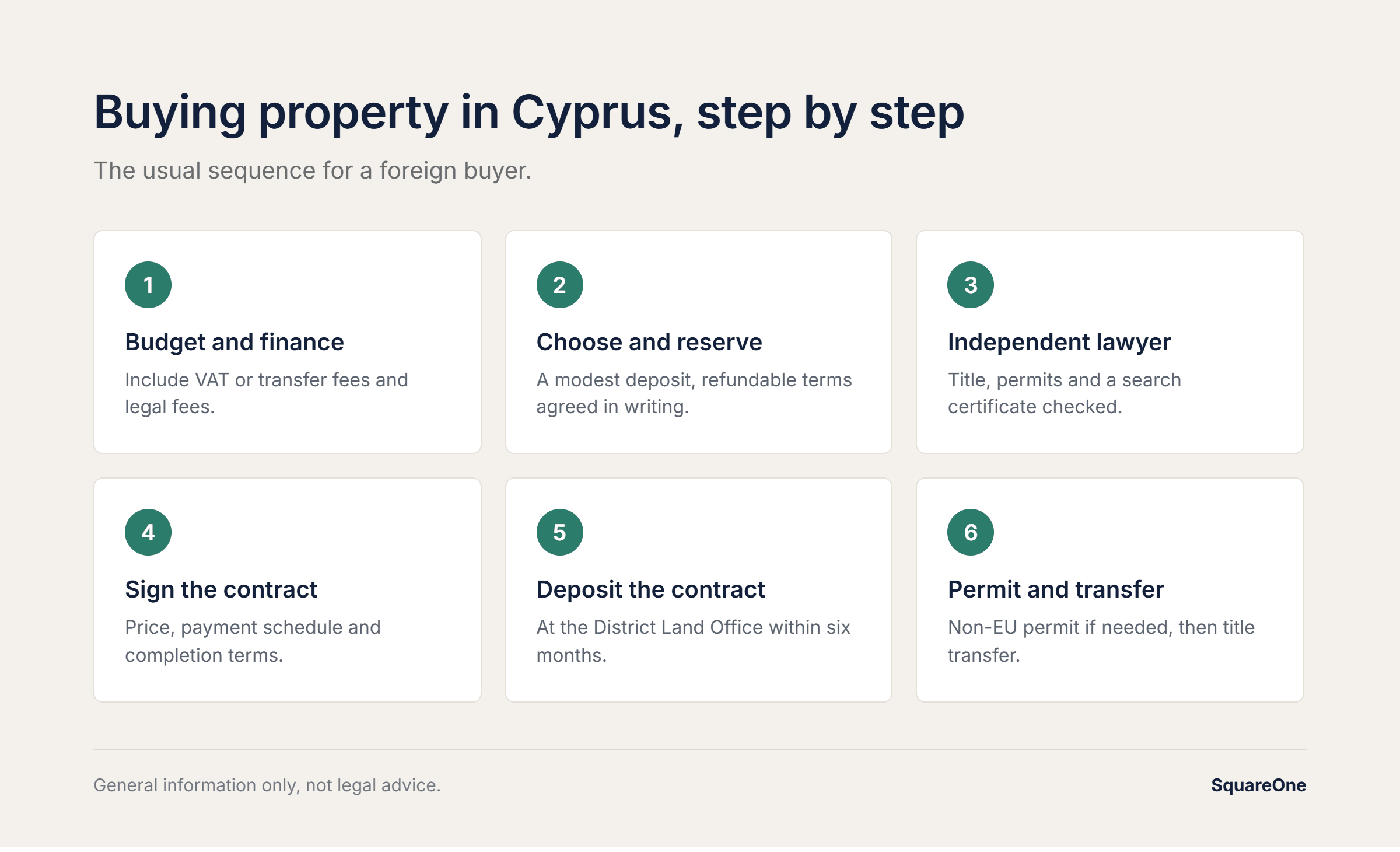
- Set your budget and financing. Include VAT or transfer fees and legal fees. If you need a mortgage, speak to a bank early: lending to non-residents is possible but needs more paperwork.
- Choose the property and reserve it. A reservation deposit takes the property off the market. Keep it modest, and agree in writing whether it's refundable.
- Appoint an independent lawyer. Your lawyer should act only for you. They check the title, any mortgages or court orders, the planning and building permits, and the search certificate, which must be dated no more than five working days before signing.
- Sign the sale contract. It sets out the price, payment schedule and completion terms. For off-plan purchases, payments are usually staged against construction milestones.
- Deposit the contract at the Land Registry. Your lawyer lodges the signed contract at the District Land Office within six months. This protects you against later claims and gives you the right to enforce the transfer.
- Apply for the non-EU permit, if it applies to you.
- Complete and transfer. Pay the balance, then transfer the title into your name at the Land Registry once the title deed exists. Transfer fees are paid at this stage on a resale.
Opening a Cyprus bank account is usually needed for payments and utilities. Banks run anti-money-laundering checks and will ask for proof of identity, address and the source of your funds, so allow time for this.
What it costs
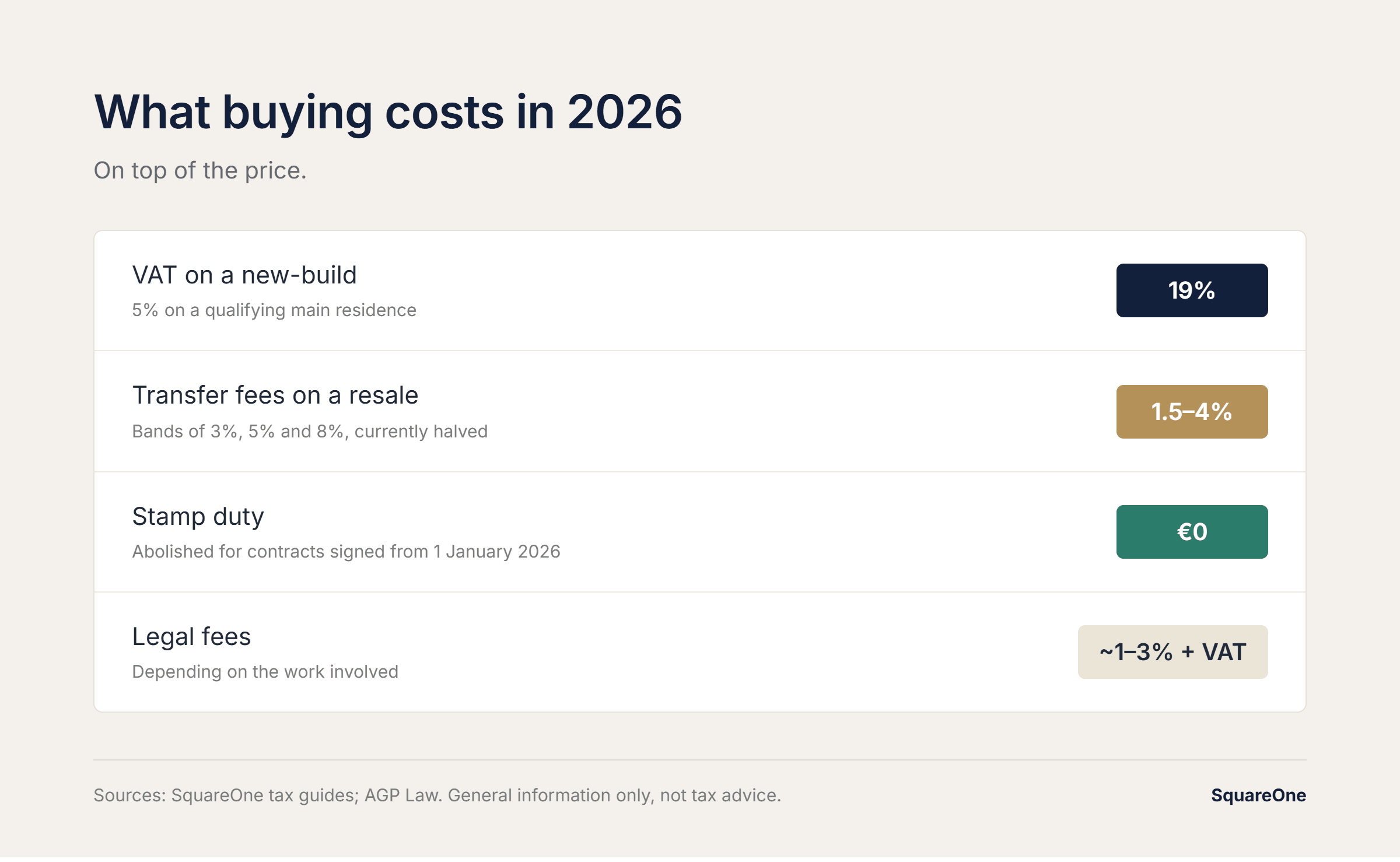
- VAT on a new-build. 19%, or 5% if the home will be your main residence and meets the limits. See our VAT guide.
- Transfer fees on a resale. Charged in bands of 3%, 5% and 8%, currently halved. See our transfer fees guide.
- No stamp duty. It was abolished for contracts signed from 1 January 2026. See Cyprus just made buying a home cheaper.
- Legal fees. Typically around 1% to 3% of the price plus VAT, depending on the work involved.
Our investor tax guide covers the taxes once you own the property, including rental income and capital gains.
Buying off-plan as a foreign buyer
Many foreign buyers buy off-plan from a developer. The steps are the same, but the checks shift towards the developer: their track record, the project's permits and how the title deeds will be issued. Read our guides to off-plan vs ready property and how to choose a developer.
Buying and residency
A non-EU buyer who buys a new home of at least €300,000 plus VAT can apply for permanent residency, subject to income conditions. Our residency guide explains the route, and our relocation guide covers the move itself.
For a sense of how quickly you need to decide once you find the right unit, see how fast property sells in Cyprus. Buyers from Israel will also find our guide for Israeli buyers useful.
Buying with SquareOne
We sell to buyers from many countries and work alongside their independent lawyers through each step. Browse our current projects or contact us to talk through a purchase.
General information only, not legal or tax advice. Rules as at November 2026. Always use an independent lawyer when buying property in Cyprus.
Frequently asked questions
Can foreigners buy property in Cyprus?
Yes. EU citizens buy on the same terms as Cypriots. Non-EU citizens need permission from the Council of Ministers, through the District Officer, and can generally buy one home or a plot of up to about 4,000 m².
How long does the non-EU purchase permit take?
Typically one to two months after the contract is signed, sometimes longer in Paphos. You can usually move in while it's pending, but the title is registered only once it's granted.
Do I need a lawyer to buy property in Cyprus?
It's strongly advisable. An independent lawyer checks the title and permits, reviews the contract, deposits it at the Land Registry and handles the transfer.
Is there stamp duty on property in Cyprus?
Not on contracts signed from 1 January 2026, when it was abolished. The main purchase taxes are VAT on new-builds or transfer fees on resales.
Can I get residency by buying property in Cyprus?
Non-EU buyers can apply for permanent residency by buying a new home of at least €300,000 plus VAT and meeting the income conditions.
Last updated
About the author

Co-Founder and CEO, SquareOne
Demetris Papadopoulos is Co-Founder and CEO of SquareOne, where he leads investment strategy and long-term asset performance. He trained as a Development Analyst at Galliard Homes in London, holds a Master's in Real Estate Investment from Bayes Business School, and co-founded MovingDoors, SquareOne's rental-management platform.
- MSc Real Estate Investment, Bayes Business School
- Co-founder, MovingDoors
- Investment and market analysis