Cyprus real estate market overview 2026: sales, prices, buyers and supply

Co-Founder and CEO, SquareOne
6 min read
On this page
Cyprus is on course for its strongest property year on record. Sale contracts reached 14,969 between January and September 2026, 14% more than in the same months of 2025, residential prices rose 8.5% year on year in the second quarter, and completed transfers were worth €3.72 billion. This overview brings the 2026 data together in one place: the economy behind the market, sales and values, who is buying, prices, supply, rents and the differences between districts, and closes with what the numbers suggest for 2027.
1. The economy behind the market
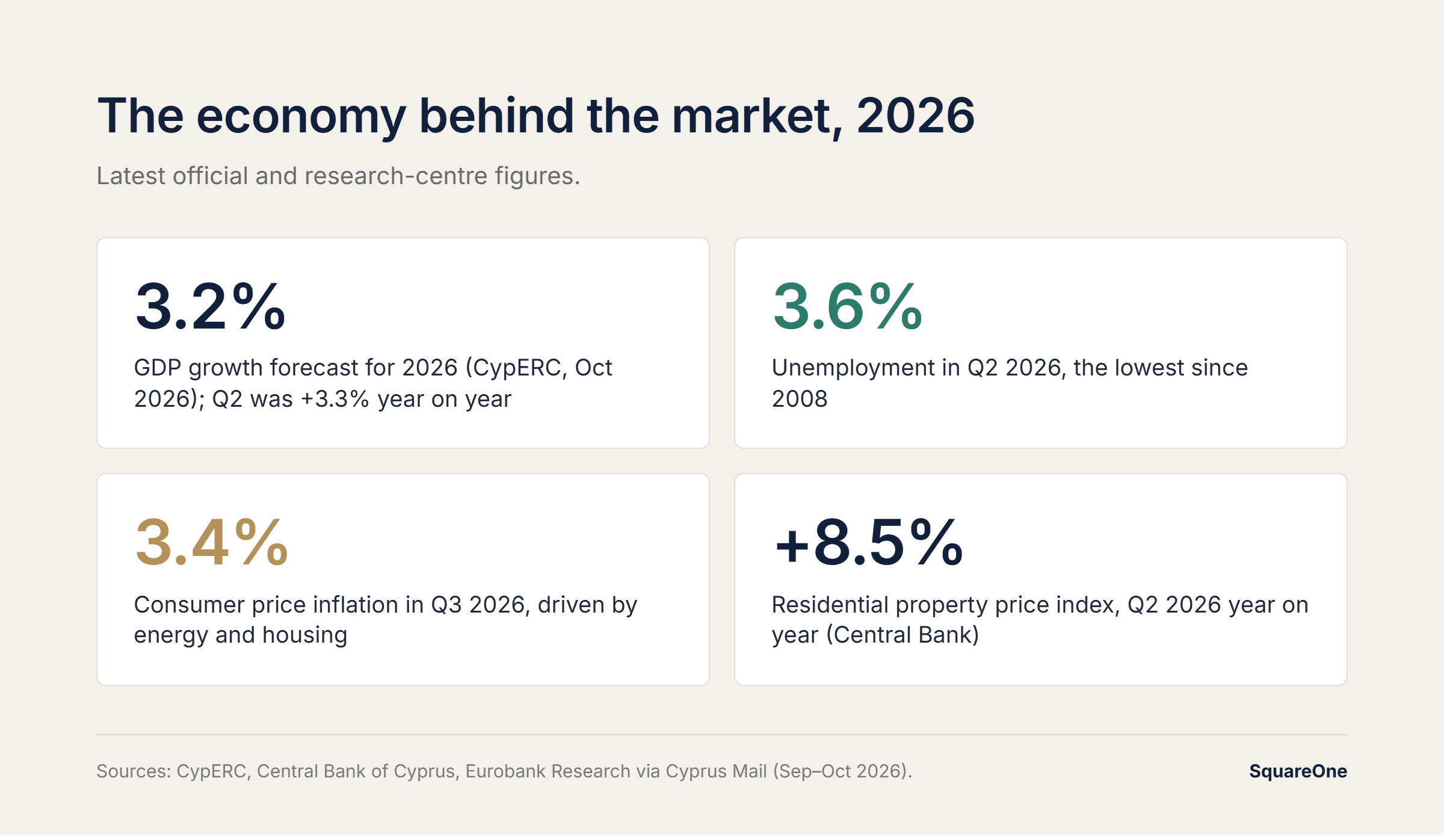
Cyprus grew 3.3% year on year in the second quarter of 2026, the fourth-highest rate in the euro area, and the Economics Research Centre raised its 2026 forecast to 3.2% in October, with 3.1% for 2027 (Cyprus Mail, October 2026). Unemployment fell to 3.6% in the second quarter, the lowest since 2008, and non-Cypriots now make up close to 28% of the workforce. Inflation picked up to about 3.4% in the third quarter, driven by energy and housing costs, and the Central Bank expects it to ease to around 2.4% in 2027. S&P upgraded Cyprus to A during the year and public debt continues to fall.
The one weak spot is tourism. Arrivals fell 7% in January to August, with a 28.6% drop in March and April during the Middle East conflict, before stabilising in the summer. Revenue held up better because spend per visitor rose; our guide to tourism and property in 2026 covers what that means for holiday lets.
2. Sales and transaction values
The Department of Lands and Surveys recorded 1,681 sale contracts in September 2026, the strongest September on record; July's 2,040 was the largest single month ever. The nine-month total of 14,969 is already 83% of 2025's full-year 18,114, which points to around 20,000 contracts for 2026 if the pace holds (Cyprus Mail, October 2026). Completed transfers for January to September were worth €3.72 billion, up 6.6%, with Limassol accounting for €1.44 billion or 38.7% (Cyprus Mail, October 2026).
| District | Contracts Jan–Sep 2026 | Change on 2025 | Foreign share of contracts |
|---|---|---|---|
| Limassol | 4,860 | +17% | 36.5% |
| Larnaca | 3,291 | +15% | 46.6% |
| Nicosia | 3,163 | +6% | 15.9% |
| Paphos | 2,999 | +18% | 69.8% |
| Famagusta | 656 | +5% | 46.5% |
3. Who is buying
Cypriot buyers signed 58% of contracts in the first nine months and non-Cypriots 42%: 2,094 contracts by EU nationals and 4,173 by non-EU nationals. Non-EU demand is the fastest-growing segment, up 26% year on year in September. The largest foreign groups by nationality are British, Russian, Israeli and Greek buyers, with Israelis the leading group in Larnaca and second in Limassol and Paphos; our guide for Israeli buyers has the detail. The gap between the foreign share of contracts (42%) and of completed transfers (21%) reflects off-plan purchases, where title passes only on completion. For the process a non-EU buyer follows, see buying property in Cyprus as a foreigner.
4. Prices
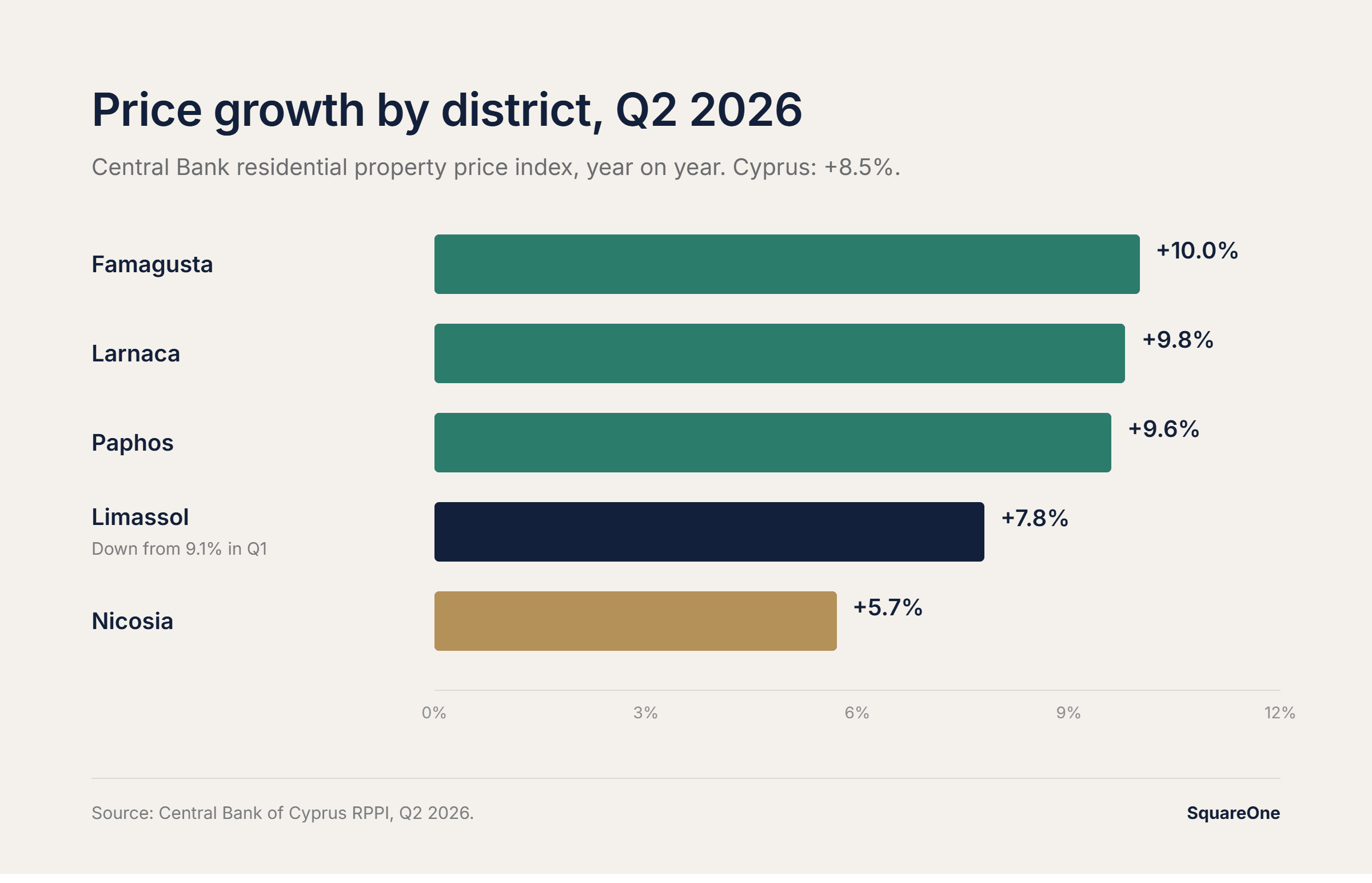
The Central Bank's residential property price index rose 8.5% year on year in the second quarter of 2026, up from 7.5% in the first, to a record level. Apartments led at 8.9% against 5.8% for houses. By district the fastest growth was in Famagusta (10.0%), Larnaca (9.8%) and Paphos (9.6%), with Limassol at 7.8% and Nicosia at 5.7%. The Central Bank attributes the rise to foreign demand first, local demand second, and construction costs, which were 3.4% higher in August than a year earlier and about 32% above 2020 (SquareOne market release, October 2026).
Within the index, 2026 has opened a gap by age of stock. Asking prices for older Limassol apartments fell 9% between February and September while new apartments held, and new two-bedroom flats command a 24% rent premium over older ones. Our analysis of Limassol investment trends and our guide to how fast property sells in 2026 go into the split.
5. Supply and building permits
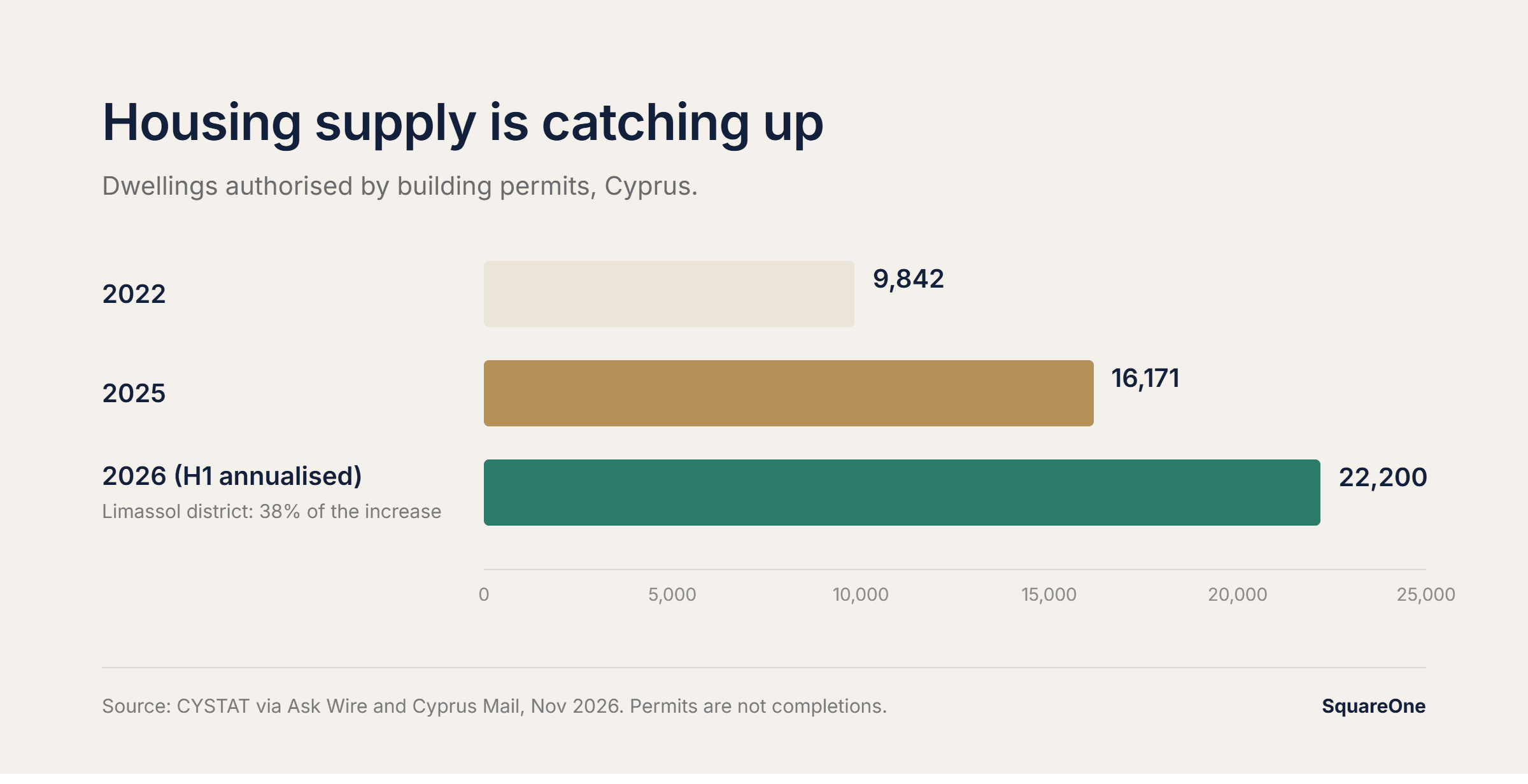
Supply is the big change of 2026. Residential building permits covered 8,978 units in January to May, 63.7% more than a year earlier, and dwellings authorised in the first half ran at an annualised 22,200 against 16,171 in 2025 and 9,842 in 2022. Limassol district accounts for 38% of the increase. In the Limassol urban area alone, 210 apartment projects with 4,932 units are under construction, 39% of them sold (Cyprus Mail, November 2026). A permit is not a completion, and construction costs and labour shortages will slow some of this pipeline, but the direction is clear: after years of undersupply, buyers will have more choice in 2027 and 2028, and the projects that complete on time and as specified will hold value while others do not. For a buyer that argues for choosing the developer carefully.
6. Rents
Bazaraki asking rents for January to August 2026 averaged €1,716 a month in Limassol, €1,131 in Paphos, €905 in Larnaca and €734 in Nicosia, and RICS and KPMG recorded apartment rental values up 7.4% year on year in the second quarter. Short-term letting is tightening: licences are mandatory, platforms verify them from May 2026 and all rent must be paid electronically from July 2026. Our Cyprus rental market overview has rents and yields by city, and our worked rental yield example shows how to model a unit. No yield is guaranteed.
7. Districts compared
Limassol is the largest market by every measure, with the highest prices, the deepest rental demand and the most new supply; it is also the most mature, with price growth now below the other coastal districts. Larnaca is the fastest-growing in 2026, lifted by the airport, the marina redevelopment and Israeli and Lebanese demand, from the lowest price base of the coastal cities. Paphos is the most international, with 70% of contracts signed by foreign buyers, and the strongest apartment price growth. Nicosia is the domestic market, 84% local, steady and the least exposed to overseas demand. Famagusta is small and seasonal. Our guide to investing in Cyprus real estate compares the districts for investors, and why Limassol is Cyprus's most desirable city makes the case for the largest one.
8. Costs and rules in 2026
Three changes affect the cost of buying this year. Land Registry transfer fees remain halved, so resale purchases pay 1.5% to 4% on a sliding scale; stamp duty on sale contracts was abolished from 1 January 2026; and the special defence contribution on rental income was removed from 2026, while GHS at 2.65% remains. VAT on new builds is 19%, or 5% on a qualifying main residence. Our investor tax guide and transfer fees guide set out the figures; this article is general information, not tax advice.
Outlook for 2027
The demand side looks durable: growth of about 3%, record employment, a widening non-EU buyer base and the prospect of Schengen accession, which the government expects in 2027 and which would remove the one disadvantage Cyprus carries against Greece and Spain for non-EU buyers (see our Schengen update). The supply side is where 2027 differs from 2024: more homes are being approved and built than at any point since the financial crisis, and the market will reward buildings that are delivered well and discount those that are not. Our Cyprus property outlook for 2027 and 2028 sets out the scenarios in more detail.
We do not forecast prices. What the data supports is a simple rule for a buyer in 2026: new or recent, well located, from a developer with a delivery record, in the €200,000 to €400,000 band where most of the market trades. Browse our current projects or contact us to talk through what fits.
Frequently asked questions
Is the Cyprus property market growing in 2026?
Yes. Sale contracts were up 14% in the first nine months of 2026 to 14,969, the residential price index rose 8.5% year on year in Q2, and the year is on course for a record of around 20,000 contracts.
How much have property prices risen in Cyprus?
8.5% year on year in Q2 2026 on the Central Bank index, with apartments up 8.9% and houses 5.8%. Growth was fastest in Famagusta, Larnaca and Paphos and slowest in Nicosia.
Who buys property in Cyprus?
Cypriots signed 58% of 2026 contracts and foreigners 42%, two thirds of them from outside the EU. British, Russian, Israeli and Greek nationals are the largest foreign groups.
Is there a housing shortage in Cyprus?
Supply is catching up. Building permits rose 63.7% in January to May 2026 and dwellings authorised in the first half ran at an annualised 22,200, more than double the 2022 level, although permits take two to three years to become completions.
Which city in Cyprus is best for property investment in 2026?
Limassol for depth of demand and rents, Larnaca for growth from a low base, Paphos for international and holiday demand, Nicosia for a stable local market. The right answer depends on whether you want rental income, capital growth or a home.
What does property cost to buy in Cyprus in 2026?
VAT at 19% (or 5% on a qualifying main residence) on new builds; halved transfer fees of 1.5% to 4% on resales; no stamp duty since January 2026; legal fees of about 1%.
Last updated
About the author

Co-Founder and CEO, SquareOne
Demetris Papadopoulos is Co-Founder and CEO of SquareOne, where he leads investment strategy and long-term asset performance. He trained as a Development Analyst at Galliard Homes in London, holds a Master's in Real Estate Investment from Bayes Business School, and co-founded MovingDoors, SquareOne's rental-management platform.
- MSc Real Estate Investment, Bayes Business School
- Co-founder, MovingDoors
- Investment and market analysis