Buy-to-Let in Limassol: A Step-by-Step Guide for Investors (2026)

Co-Founder and CEO, SquareOne
5 min read

On this page
Buying to let in Limassol means buying in the most expensive rental market in Cyprus, where rents are highest and yields lead the island. Returns depend less on the building's finish than on three choices: the size of the apartment, its location, and whether you let it long term or to holidaymakers. This guide covers what yields look like in 2026, what you pay to buy and run a rental property, and the steps from search to tenant.
Why investors look at Limassol
Limassol has the deepest long-term rental demand in Cyprus, driven by international companies in shipping, tech, finance and professional services and the people who move for them. A typical two-bedroom apartment rents for about €1,400 to €1,500 a month, against €800 to €900 in Nicosia.
Rents held steady in 2026 after several years of rises, while prices kept climbing. Our Cyprus rental market overview covers the trend by city. For an investor, that means planning on today's rents rather than expecting them to keep rising.
Which apartments yield most
Smaller apartments earn more rent per euro invested. In the first quarter of 2026, Global Property Guide put typical Limassol asking prices, rents and gross yields at:
| Apartment | Typical price | Typical rent per month | Gross yield |
|---|---|---|---|
| One-bedroom | €265,000 | €1,300 | 5.9% |
| Two-bedroom | €417,000 | €2,000 | 5.8% |
| Three-bedroom | €750,000 | €2,700 | 4.3% |
These are asking figures for well-located apartments and will vary by area and building. The pattern holds, though: tenants pay for bedrooms and location more than for extra square metres. That is why a compact, well-planned layout often earns as much rent as a larger one at a lower price. For more on unit choice, see studio or two-bedroom for investment and our guide to studio apartments in Limassol.
Long-term or short-term let
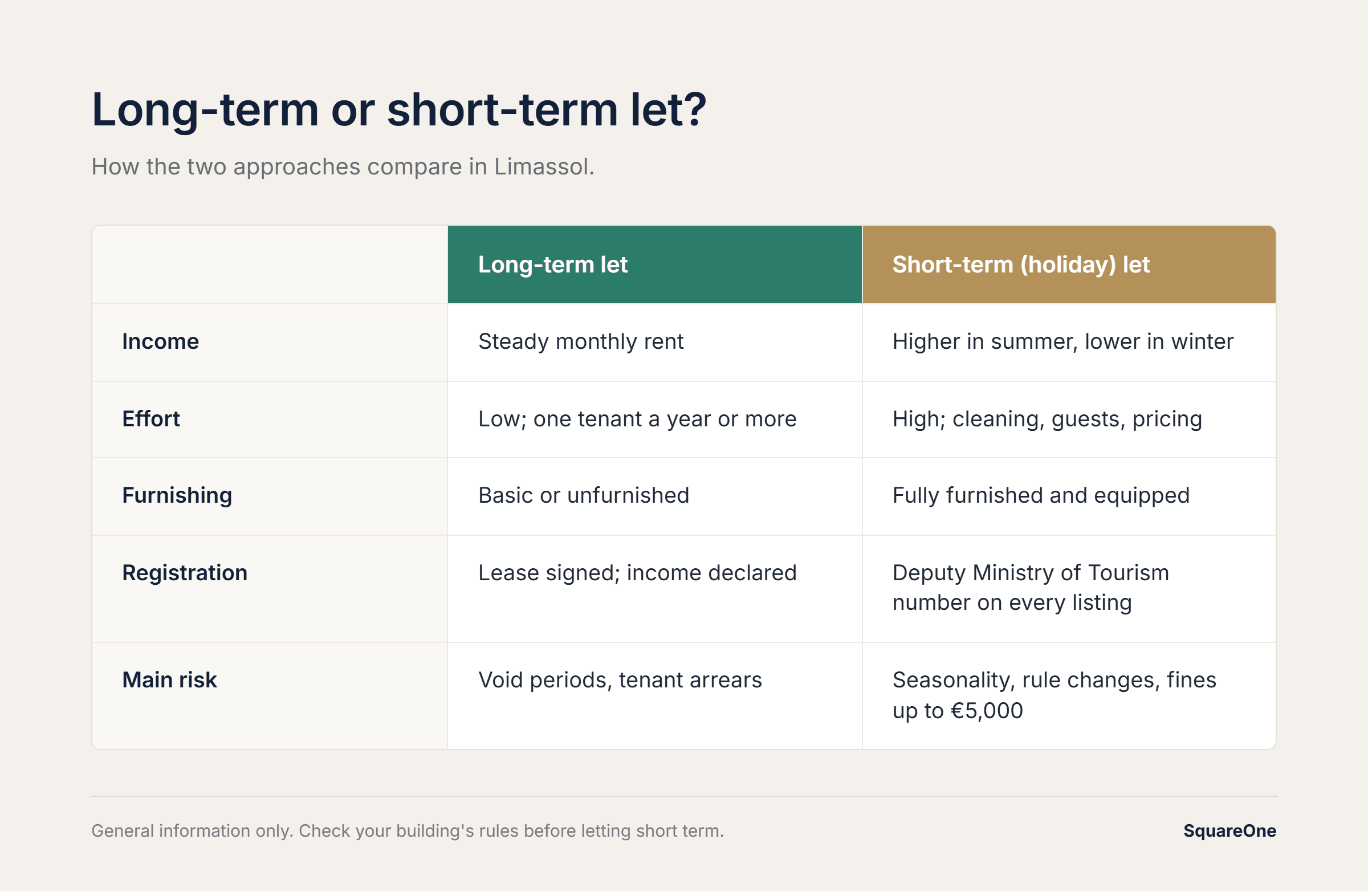
Most buy-to-let investors in Limassol let long term, on leases of a year or more. Income is steadier, management is simpler and furnishing costs are lower. Holiday lets can earn more per night in summer but less in winter, need more management, and must be registered with the Deputy Ministry of Tourism, with the registration number shown on every listing. Letting without registration can lead to a fine of up to €5,000. Building rules may also restrict short lets, so check them before you buy.
What it costs to buy
The main purchase taxes depend on whether you buy new or resale:
- VAT on a new-build. A property bought to let pays the standard 19% VAT. The reduced 5% rate applies only to a main residence. See our VAT guide.
- Transfer fees on a resale. If no VAT is due, you pay transfer fees at the Land Registry, currently reduced by 50%. See property transfer fees in Cyprus.
- No stamp duty. Stamp duty was abolished for contracts signed from 1 January 2026. See Cyprus just made buying a home cheaper.
- Legal fees for an independent lawyer to check the title, review the contract and deposit it at the Land Registry.
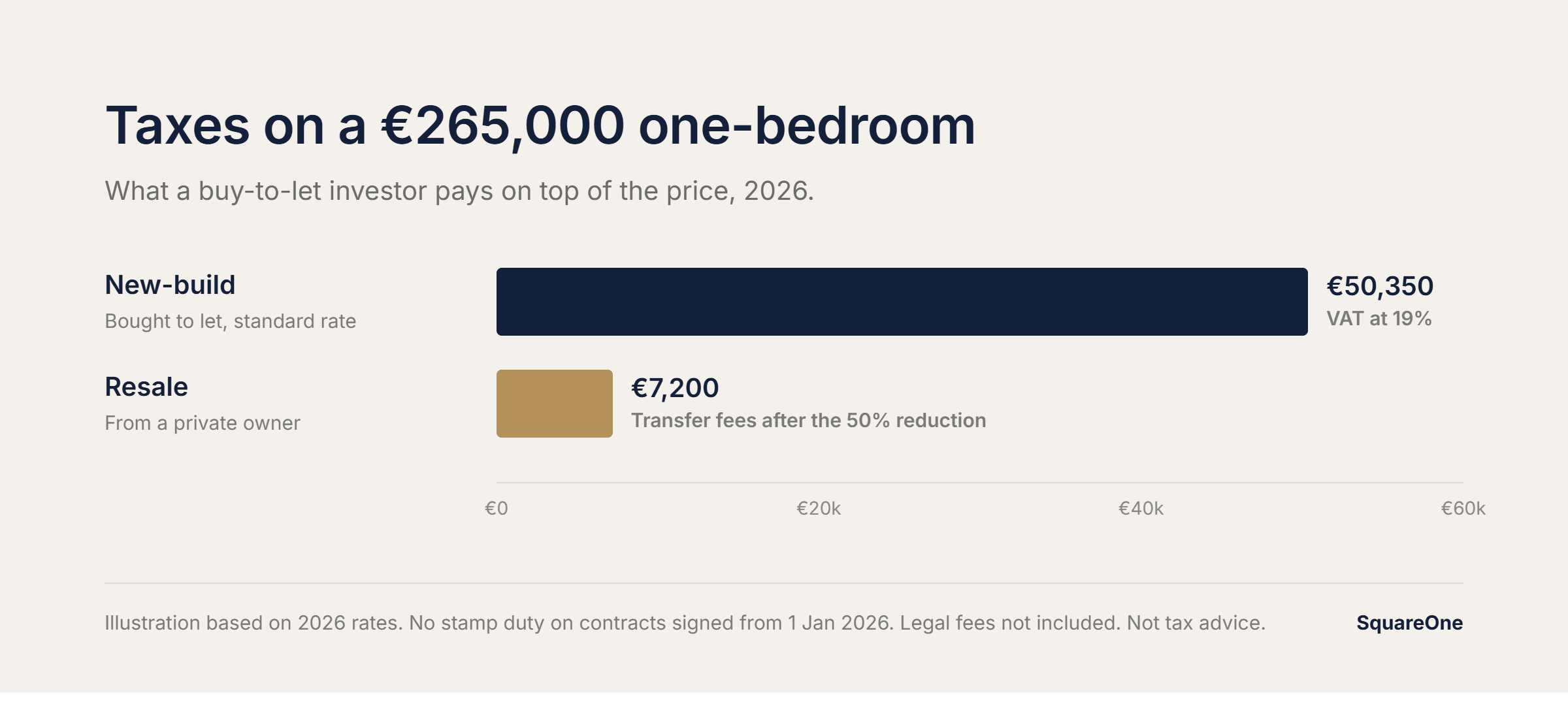
Our investor tax guide brings all the purchase and ownership taxes together.
What it costs to run
Gross yield ignores the costs of owning a rental. Budget for:
- property management, if you use a manager, usually charged as a share of the rent
- common expenses for the building
- insurance, maintenance and periods between tenants
- income tax and contributions on rental income (see rental income tax in Cyprus)
Global Property Guide estimates net yields at 1.5 to 2 percentage points below gross. On the one-bedroom example above, a 5.9% gross yield would be roughly 3.9% to 4.4% net. That is an illustration, not a forecast. For a full calculation, see how to calculate rental yield on a Limassol apartment.
Step by step: from search to tenant
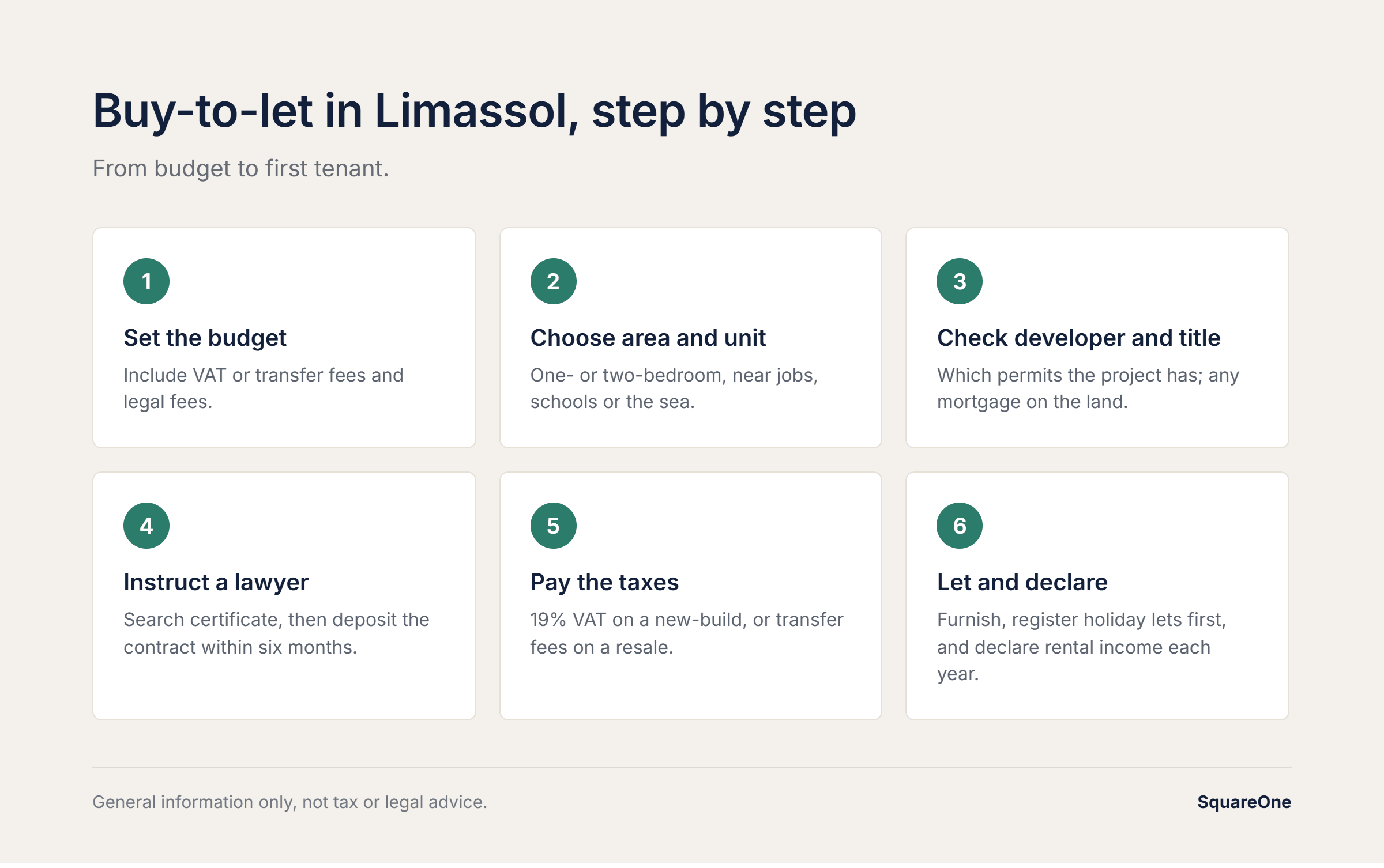
- Set the budget and the target. Decide whether you're optimising for yield, long-term growth or future personal use, and include VAT or transfer fees in the budget.
- Choose the area and unit. Look for one- or two-bedroom apartments near business districts, schools and the seafront. Our guide to the best areas in Limassol compares neighbourhoods.
- Check the developer and the title. For new-builds, ask which permits the project has. Read how title deeds work in Cyprus and how to choose a developer.
- Instruct a lawyer. Get a current search certificate and deposit the signed contract at the Land Registry within six months.
- Pay the taxes. VAT on a new-build, or transfer fees on a resale, when the title is transferred.
- Prepare and let. Furnish to the level the market expects. For holiday lets, register with the Deputy Ministry of Tourism first.
- Declare the income. Register for tax and declare rental income each year.
Buying to let and residency
A new property of at least €300,000 (plus VAT) can support an application for Cyprus permanent residency through investment, subject to the programme's conditions. Check how renting out the property fits those conditions before you commit.
For the wider market picture, see investing in Limassol property in 2026, and if you're considering a larger unit, our guide to buying a penthouse in Limassol.
Before choosing a holiday let over a long tenancy, read our guide to tourism and property in Cyprus in 2026, which covers the licence, the fines and what a holiday let actually earns.
How SquareOne designs for investors
We plan our Limassol apartments around what tenants pay for: the number of bedrooms, natural light, storage and location, rather than extra floor area that adds to the price but not the rent. We explain that approach in why we start with ROI, not architecture. Browse our current projects, from ready-to-move-in apartments such as URBN to new developments, or contact us to talk through a buy-to-let purchase.
General information only, not investment or tax advice. Rents and yields are not guaranteed and vary by property. Figures as published at the dates linked.
Frequently asked questions
Is buy-to-let in Limassol still worth it in 2026?
Limassol has the highest rents and gross yields of Cyprus's main cities, averaging about 5.3% gross in early 2026. Rents were flat in 2026 while prices rose, so returns depend on buying the right unit at the right price. Returns aren't guaranteed.
What rental yield can I expect in Limassol?
Typical gross yields in the first quarter of 2026 were about 5.9% for one-bedroom apartments, 5.8% for two-bedrooms and 4.3% for three-bedrooms. Net yields are usually 1.5 to 2 points lower.
Do I pay 19% VAT on a buy-to-let apartment in Cyprus?
On a new-build, generally yes. The reduced 5% rate applies only to a property used as your main residence. A resale property pays transfer fees instead of VAT.
Can I rent my Limassol apartment on Airbnb?
Yes, if you register it with the Deputy Ministry of Tourism and show the registration number in every listing, and the building's rules allow it. Unregistered short-term letting can lead to a fine of up to €5,000.
Can foreigners buy property to let in Cyprus?
Yes. EU citizens buy on the same terms as Cypriots. Non-EU buyers generally need permission from the District Officer, which is a routine step for one home. Your lawyer handles it.
Last updated
About the author

Co-Founder and CEO, SquareOne
Demetris Papadopoulos is Co-Founder and CEO of SquareOne, where he leads investment strategy and long-term asset performance. He trained as a Development Analyst at Galliard Homes in London, holds a Master's in Real Estate Investment from Bayes Business School, and co-founded MovingDoors, SquareOne's rental-management platform.
- MSc Real Estate Investment, Bayes Business School
- Co-founder, MovingDoors
- Investment and market analysis