This website uses cookies to enhance your user experience.
By using our website, you consent to all cookies in accordance with our Cookie Policy, Privacy Policy, and Terms & Conditions.

8 January 2026
For international property investors, regulatory shifts often create the largest pricing inflection points. Not because they change fundamentals overnight, but because they reposition a market within the global investment landscape.
Cyprus’s progress toward Schengen membership in 2026 is one such moment.
While Cyprus is not yet part of the Schengen Area, official government statements and EU integration milestones indicate that accession is now a realistic near term objective.
For investors, this is not an administrative footnote. It directly affects mobility, tourism flows, residency attractiveness, and the long term positioning of Cyprus real estate within the European market.
This update consolidates the most credible public information available and explains what Schengen membership could realistically change for Cyprus’s investment environment.
Cyprus remains outside the Schengen Area as of January 2026, but the accession process is now in its final technical and political phases.
Key takeaways:
For property investors, Schengen accession represents a structural upgrade. It enhances international mobility, strengthens the strategic value of residency, and increases the appeal of Cyprus property within a fully integrated European framework.
No. As of January 2026, Cyprus is an EU member state but not a Schengen member.
This means:
However, the government has confirmed that accession is actively progressing.
The Deputy Minister for Migration stated that Cyprus is technically prepared for Schengen membership and that EU level assessments are underway, with the objective of securing political approval during 2026.
The President publicly confirmed that all technical requirements were expected to be resolved by the end of 2025, and that the political dimension of the process had already been addressed.
Cyprus has formally pursued Schengen accession since 2019. A key breakthrough came in July 2023, when the country successfully integrated into the Schengen Information System. Further alignment followed in 2024 and 2025 through the adoption of EU wide border and travel systems.
Important for investors: Schengen accession requires unanimous political approval by EU member states. Even when technical readiness is achieved, timing remains subject to EU level decision making.
Yes. Cyprus recognises valid multiple or double entry Schengen visas as equivalent to a national visa for short stays of up to 90 days.
No. A Cyprus visa or residence permit does not currently allow travel within the Schengen Area.
This distinction remains important when comparing Cyprus with jurisdictions already inside the Zone.
Even before Cyprus formally joins Schengen, Europe is implementing new border systems:
For investors, these systems influence business mobility, tourism behaviour, and travel friction, with direct implications for hospitality, serviced living, and short term rental markets.
Schengen accession does not automatically reprice a market. However, in internationally oriented economies such as Cyprus, it materially alters accessibility, perception, and buyer confidence.
Once Cyprus joins Schengen, Cyprus residence permits would allow passport free movement across the Schengen Area. This significantly increases the strategic value of Cyprus residency for non EU nationals seeking a European base.
This directly supports:
Cyprus recorded over 4 million tourist arrivals in 2024, surpassing pre pandemic levels. Easier multi destination travel within Europe typically supports higher visitor volumes, longer itineraries, and improved off season occupancy.
For property investors, this underpins:
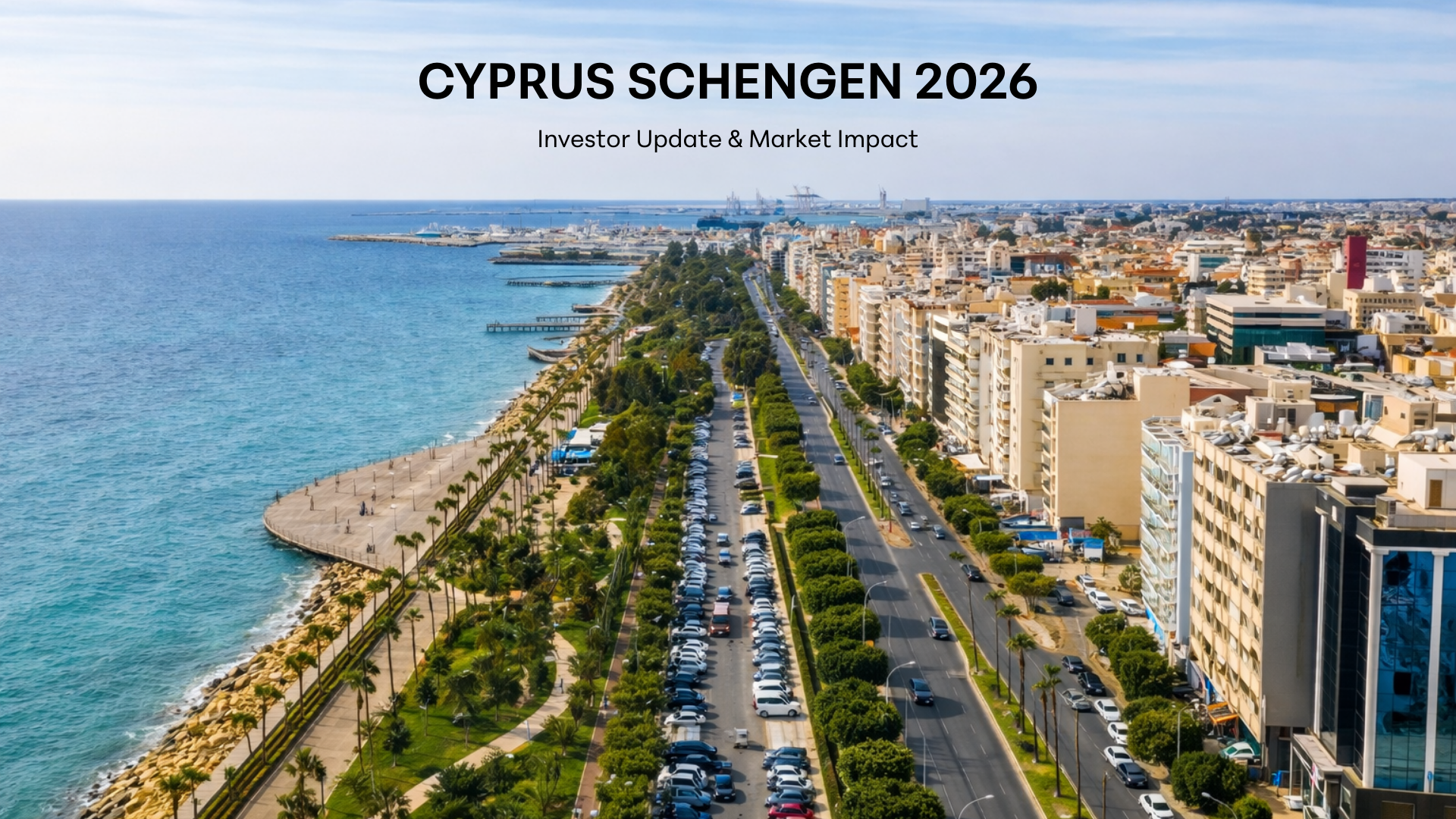
Limassol Cyprus’s business, marina, and high end residential hub. Already heavily internationalised, with strong foreign buyer participation in new developments. Schengen membership would further enhance cross border mobility for owners, tenants, and investors.
Nicosia A growing centre for education, corporate services, and administration. Increased residency driven demand supports medium and long term rental absorption and mixed use development.
In comparable European markets, Schengen accession has consistently increased international visibility and reduced barriers to foreign ownership, contributing to stronger demand in prime residential zones.
While outcomes depend on broader macroeconomic conditions, supply pipelines, and interest rates, the structural effects of Schengen membership are clear:
This pattern has been observed in other jurisdictions following Schengen integration, particularly in tourism oriented and lifestyle driven markets.
Investors should remain aware of potential constraints:
No formal accession date has yet been announced.
Cyprus joining the Schengen Area would represent one of the most meaningful upgrades to the country’s investment profile since EU accession and Euro adoption.
For international property investors, the implications are clear:
While political approvals are still pending, the technical foundation is in place and official messaging remains aligned around a 2026 target.
For investors, the period before full accession represents a window to acquire assets ahead of a potential structural shift in demand.
If you are evaluating Cyprus property as part of a broader European investment strategy, now is the time to assess assets positioned to benefit from increased international demand, improved mobility, and long term market integration.
Explore Square One’s off plan investment opportunities: https://www.squareone.com.cy/projects
Or speak with our team to understand which developments are strategically aligned with Cyprus’s next phase of growth.